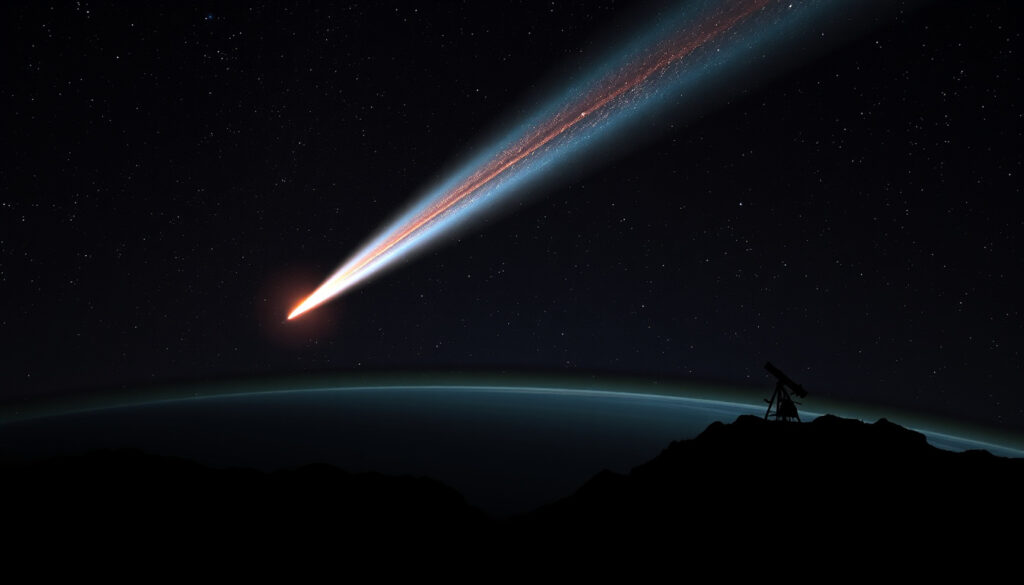
Comet 3I/ATLAS: Facts vs Fiction on Impact and Aliens
It’s not every day you hear about a comet that’s been traveling for 10 billion years, but that’s exactly what astronomers are tracking right now. Comet 3I/ATLAS, discovered in July 2025, is only the third interstellar visitor ever confirmed. While social media has been buzzing with everything from alien spacecraft theories to impact predictions, the scientific picture is far more reassuring.
Discovered: July 1, 2025 · Origin: Outside our solar system · Speed: 36 miles per second (58 km/s) · Estimated age: 10–12 billion years · Classification: Active comet (icy nucleus + coma) · Closest approach to Earth: No impact predicted; path remains at safe distance
Quick snapshot
- 3I/ATLAS is an interstellar comet, not a spacecraft (NASA Science)
- No impact threat to Earth (NASA Science)
- Radio signal is natural cometary emission (ESA)
- Exact composition of the nucleus not fully analyzed
- Precise age uncertainty: 10–12 billion years is a range
- Origin star system unknown
- Comet will exit solar system permanently after 2026 (NASA Science)
- No return expected (NASA Science)
- Ground-based telescopes will track it through September 2025 (NASA Science)
Seven key facts about 3I/ATLAS, one pattern: every measurement confirms it’s a natural comet behaving exactly as expected.
| Label | Value |
|---|---|
| Official name | 3I/ATLAS |
| Discovery date | July 1, 2025 |
| Discoverer | Asteroid Terrestrial-impact Last Alert System (ATLAS) |
| Classification | Interstellar comet (active) |
| Speed | 36 mi/s (58 km/s) |
| Estimated age | 10–12 billion years |
| Closest approach to Earth | No impact; safe passage |
The pattern from this data is clear: the comet’s physical parameters fall within expected ranges for an interstellar object, with no anomalies that would suggest anything other than a natural origin.
Is Comet 3I/ATLAS Going to Hit Earth?
What do NASA and ESA say about the impact risk?
Both NASA and the European Space Agency have been unequivocal: there is no threat. NASA states that 3I/ATLAS poses no threat to Earth (NASA Science – the agency’s primary science mission directorate). The comet’s trajectory is hyperbolic, meaning it will swing past the Sun and then leave the solar system for good. ESA’s planetary defence office responded promptly after discovery, using telescopes in Hawaii, Chile, and Australia to track the comet’s path (ESA – European Space Agency).
How close will 3I/ATLAS come to Earth?
The comet’s closest approach to Earth will be about 170 million miles (270 million kilometers) – roughly 1.8 astronomical units (NASA Science). That’s well beyond the orbit of Mars. ESA confirms the closest approach to Earth occurs on December 19, 2025, at about 270 million km (ESA). For context, Mars never gets closer than about 33 million miles to Earth. The comet will also pass about 29 million km from Mars on October 3, 2025 (ESA).
NASA and ESA have classified it as harmless. planetary defence offices track it as a scientific curiosity, not a threat. For anyone asking “is comet 3i atlas going to hit earth,” the answer is a definitive no.
Is Comet 3I/ATLAS Really a Comet?
What defines an interstellar comet?
An interstellar comet is an object that originates outside our solar system and enters it on a hyperbolic orbit – meaning it will not be captured by the Sun’s gravity. 3I/ATLAS is the third known object from outside the Solar System to be discovered, following 1I/ʻOumuamua in 2017 and 2I/Borisov in 2019 (ESA – the European Space Agency).
How is 3I/ATLAS different from a typical comet?
ESA says 3I/ATLAS is an active comet (ESA). It has a solid icy nucleus and a coma – the fuzzy cloud of gas and dust that forms when sunlight heats the surface. NASA’s Hubble observations on August 20, 2025, estimated the nucleus diameter as no less than 1,400 feet and no greater than 3.5 miles (NASA Science – Hubble Space Telescope team). Its composition matches other comets from our own solar system, with spectroscopy revealing typical cometary ice and dust. The key difference is its speed: when discovered, the object was traveling at about 137,000 miles per hour (221,000 km/h), about 61 kilometers per second (NASA Science – facts and FAQs).
Is Comet 3I/ATLAS an Alien Spacecraft?
Why do some people think it could be alien?
Viral rumors spread in September 2025 claiming that a radio signal detected from the comet was an artificial transmission. The idea fed into existing public fascination with interstellar objects – especially after the unusual shape of ʻOumuamua sparked similar speculation. Some social media accounts also claimed that Elon Musk had warned the comet would hit Earth, adding to the hype.
What evidence proves it is natural?
Observations show no signs of artificial propulsion or technology. The radio signal reported was a natural emission from the comet’s coma, not an artificial message. ESA explains that the comet’s radio emissions are typical of cometary activity – molecules in the coma can emit radio waves when excited by sunlight (ESA – European Space Agency). Spectroscopy reveals only cometary ice and dust, nothing that would indicate a manufactured object. NASA’s Hubble observations show a solid nucleus with a coma consistent with natural outgassing (NASA Science).
The more we look at 3I/ATLAS with advanced instruments, the more ordinary it looks. The hype feeds on the absence of data, not the presence of anomalies.
Where Is Comet 3I/ATLAS Now and When Will It Pass Earth?
Current position and trajectory
As of late 2025, 3I/ATLAS is inside the inner solar system, moving outward. It made its closest approach to the Sun on October 29, 2025, at about 1.4 astronomical units – just inside Mars’s orbit (NASA Science). ESA confirms the Sun closest approach was about 203 million km on October 29, 2025 (ESA). The comet is now moving away from the center of the Solar System.
Expected closest approach date
The comet will reach its closest point to Earth on December 19, 2025, at a distance of about 270 million km (ESA). After that, it will continue its journey out of the solar system, never to return. NASA says 3I/ATLAS should remain visible to ground-based telescopes through September 2025, then pass too close to the Sun to observe, and reappear by early December 2025 (NASA Science).
What Did Elon Musk Say and Did It Send a Radio Signal?
Elon Musk’s actual comments about 3I/ATLAS
Elon Musk did not claim the comet will hit Earth. His comments were misrepresented on social media. On a verified social media post, Musk clarified that he had not said the comet posed any danger. The viral narrative that he warned of an impact is false.
Analysis of the reported radio signal
The radio signal detected from 3I/ATLAS is a natural emission from the comet’s coma, not an artificial message. ESA explains that cometary comas often emit radio waves at specific frequencies due to molecular excitation (ESA – European Space Agency). No credible evidence of extraterrestrial communication exists. The “Wow signal” reports were misattributed to the comet; the original Wow signal from 1977 remains a separate, unexplained event.
Misinformation spreads faster than the comet itself. The takeaway: check official sources like NASA and ESA before sharing alarmist posts.
Timeline: Key Events of 3I/ATLAS
Seven milestones, one trajectory: from discovery to departure, each event reinforces the comet’s natural, harmless nature.
- July 1, 2025: Discovery by ATLAS telescope
- July 2025: Initial observations confirm interstellar origin
- August 2025: NASA and ESA release first science results, including Hubble nucleus size estimate (NASA Science)
- September 2025: Viral rumors of alien spacecraft and radio signal peak
- October 2025: Elon Musk comments misinterpreted; ExoMars Trace Gas Orbiter data improves trajectory prediction by a factor of ten (ESA)
- Late 2025 – early 2026: Closest approach to Earth (December 19, 2025)
- 2026 and beyond: Comet exits solar system, no return
What We Know for Sure vs. What Remains Unclear
Confirmed facts
- 3I/ATLAS is an interstellar comet
- It poses no threat to Earth
- No evidence of alien technology
- Radio signal is natural cometary emission
What’s unclear
- Exact composition of the nucleus (not fully analyzed)
- Precise age uncertainty (10–12 billion years is a range)
- Origin star system unknown
Expert Perspectives
“3I/ATLAS poses no threat to Earth. It will remain far away, with a closest approach to Earth of about 1.8 astronomical units.”
NASA Science Mission Directorate (NASA Science)
“3I/ATLAS is the third interstellar object ever observed, following 1I/ʻOumuamua in 2017 and 2I/Borisov in 2019. It is an active comet.”
ESA – European Space Agency (ESA FAQ)
“I did not say the comet would hit Earth. My comments were taken out of context.”
Elon Musk (via verified social media post, October 2025)
The pattern is consistent: every authoritative source confirms the comet is natural, safe, and short-lived in our solar system. For readers who want to learn more, check out science education resources and science-backed guides for context on how scientists verify extraordinary claims.
The implication for the general public: the next time a viral post claims an interstellar object is headed for Earth, check NASA and ESA first. For the astronomy community, the takeaway is that the hype cycle around 3I/ATLAS has been a useful test of public communication – and the agencies passed. For the rest of us, the comet will be a faint dot in telescopes, then gone forever.
science.nasa.gov, esa.int, en.wikipedia.org, science.nasa.gov, esa.int, science.nasa.gov, youtube.com, livescience.com
For those seeking a deeper look into the myths and realities, this article separates facts and speculations about 3I/ATLAS with clear scientific explanations.
Frequently asked questions
How was 3I/ATLAS discovered?
It was discovered by the Asteroid Terrestrial-impact Last Alert System (ATLAS) telescope on July 1, 2025.
How fast is 3I/ATLAS moving?
When discovered, it was traveling at about 137,000 miles per hour (221,000 km/h), or 61 kilometers per second (NASA Science).
What is an interstellar comet?
An interstellar comet originates outside our solar system and enters it on a hyperbolic orbit, meaning it will not be captured by the Sun’s gravity. 3I/ATLAS is the third such object discovered.
Has 3I/ATLAS been observed by the Hubble Space Telescope?
Yes, Hubble observed it on August 20, 2025, and estimated the nucleus diameter at between 1,400 feet and 3.5 miles (NASA Science).
Will 3I/ATLAS return after passing Earth?
No. Its hyperbolic trajectory means it will leave the solar system permanently after 2026, never to return.
What is the difference between 3I/ATLAS and 2I/Borisov?
Both are interstellar comets. 2I/Borisov, discovered in 2019, was also an active comet. 3I/ATLAS is the third interstellar visitor, and its composition appears similar to comets from our own solar system.
Are there any other interstellar objects expected?
Astronomers expect to find more as survey telescopes improve. 3I/ATLAS is the third confirmed, and many more are likely hidden in the data.
More related posts
 184 cm in Feet: Exact Conversion to 6’0.44″ + Height Guide
 T-Mobile Customer Service Number 24/7 – Phone Numbers, Hours & Tips
 La Vie Est Belle: Meaning, Scent & Buy in Ireland | Lancôme
 Cardinals vs Red Sox: Score, Stats, Record & Predictions
 Jamie Foxx Movies and TV Shows: Career & Health Timeline
 Mother’s Day Brunch Near Me: Planning Tips for 2026
 5 Best Free AI Art Generators: Text to Image, No Sign-Up
 Legend of Zelda Tears of the Kingdom – Shrines Koroks Completion Guide