100 Grams to Cups: Guide for Flour, Sugar, Butter & More
Few kitchen moments are more frustrating than finding a recipe in cups when your scale reads grams. You’ve got 100 grams of flour, the recipe demands 0.8 cups, and suddenly you’re debating whether a heaping or level scoop is the right call. This guide breaks down exactly what 100 grams equals in cups for flour, sugar, butter, and other common ingredients — and shows you how to measure without a scale at all.
100 grams of all-purpose flour: 0.8 cups (US) ·
100 grams of granulated sugar: 0.5 cups (US) ·
100 grams of butter: 0.44 cups (US) ·
100 grams of water: 0.42 cups (US) ·
100 grams of honey: 0.3 cups (US)
Quick snapshot
- 100g = 0.8 cups (The Calculator Site conversion guide)
- Density: 125g/cup (Doves Farm baking conversion chart)
- Use spoon-and-level method (The Calculator Site conversion guide)
- 100g = 0.5 cups (Omni Calculator grams-to-cups tool)
- Density: 200g/cup (Doves Farm baking conversion chart)
- Scoop and level for accuracy (Omni Calculator grams-to-cups tool)
- 100g = 0.44 cups (7 tbsp) (Inch Calculator conversion tool)
- Density: 227g/cup (The Calculator Site culinary conversions)
- 1 stick = 113g; just under 1 stick (Inch Calculator conversion tool)
- 100g = 0.42 cups (King Arthur Baking ingredient weight chart)
- Density: 236.6g/cup (approx.) (King Arthur Baking ingredient weight chart)
- Use liquid measuring cup at eye level (King Arthur Baking ingredient weight chart)
These conversions for 100 grams illustrate the range across common ingredients — from fluffy flour to dense honey.
| Ingredient | 100g in Cups (US) | Density (grams/cup) |
|---|---|---|
| All-purpose flour | 0.8 cups | 125g/cup |
| Granulated sugar | 0.5 cups | 200g/cup |
| Butter | 0.44 cups | 227g/cup |
| Water | 0.42 cups | ~236.6g/cup |
| Honey | 0.3 cups | ~340g/cup |
| Powdered sugar | 0.83 cups | ~120g/cup |
| Brown sugar (packed) | 0.51 cups | ~220g/cup |
What is 100g in cups?
100 grams is a weight measurement; cups measure volume. There is no single answer to “100g equals how many cups” because the conversion depends entirely on the ingredient’s density — how tightly the substance packs into a given space. This is the fundamental principle behind every grams-to-cups converter.
The basic conversion formula
The formula is straightforward once you know the ingredient’s density: cups = grams ÷ (density in grams per cup). For all-purpose flour at 125 grams per cup, 100g ÷ 125 = 0.8 cups. For granulated sugar at 200 grams per cup, 100g ÷ 200 = 0.5 cups. The BBC Good Food conversion guide applies this same logic across hundreds of ingredients.
Why ingredient density matters
Five key ingredients, five different cup values for the same 100 grams. Water (density ~236.6g/cup) yields 0.42 cups, while honey (density ~340g/cup) yields just 0.3 cups. The Industry Kitchens conversion guide illustrates this variability clearly: 100 grams of cake flour (0.88 cups) is nearly twice the volume of 100 grams of granulated sugar (0.5 cups). The pattern: lighter, fluffier ingredients like flour require more cup volume per 100g than dense ingredients like sugar or honey.
Density is the gatekeeper. Without knowing the grams-per-cup value for your specific ingredient, any conversion is a guess. Baking conversion charts from Allrecipes cup-to-gram chart standardize these values for home bakers: 1 cup flour = 120-125g, 1 cup sugar = 200g, 1 cup butter = 227-240g depending on region.
Home bakers using US volume-based recipes face a 0.5-cup gap between 100g of flour (0.8 cups) and 100g of sugar (0.5 cups). Swapping ingredients without adjusting volume will throw off texture and sweetness every time.
Is 100g the same as 1/2 cup?
Only for ingredients whose density is exactly 200 grams per cup. For most ingredients, 100g is not 1/2 cup — and assuming otherwise is a common kitchen pitfall.
When 100g equals 1/2 cup exactly
Granulated sugar is the textbook match. Since Baking Scale Pro converter and The Calculator Site culinary conversions both list 1 cup of granulated sugar at 200 grams, 100 grams lands precisely at 0.5 cups. Brown sugar (packed) comes close at ~220g/cup, giving 100g ≈ 0.45 cups — not quite half.
Common ingredients that match 1/2 cup
- Granulated sugar: 100g = 0.5 cups exactly
- All-purpose flour: 100g = 0.8 cups — not 1/2 cup
- Butter: 100g = 0.44 cups — just shy of 1/2 cup
- Powdered sugar: 100g = 0.83 cups — much more than 1/2 cup
The implication: if a recipe calls for 100 grams of an ingredient and you reach for a 1/2-cup measure without checking density, you’re accurate only for granulated sugar. For flour, you’d under-measure by 38%.
How do I measure 100 grams?
Two routes exist: the precise method (kitchen scale) and the practical method (measuring cups with conversion knowledge). Both work, but they serve different situations.
Using a kitchen scale
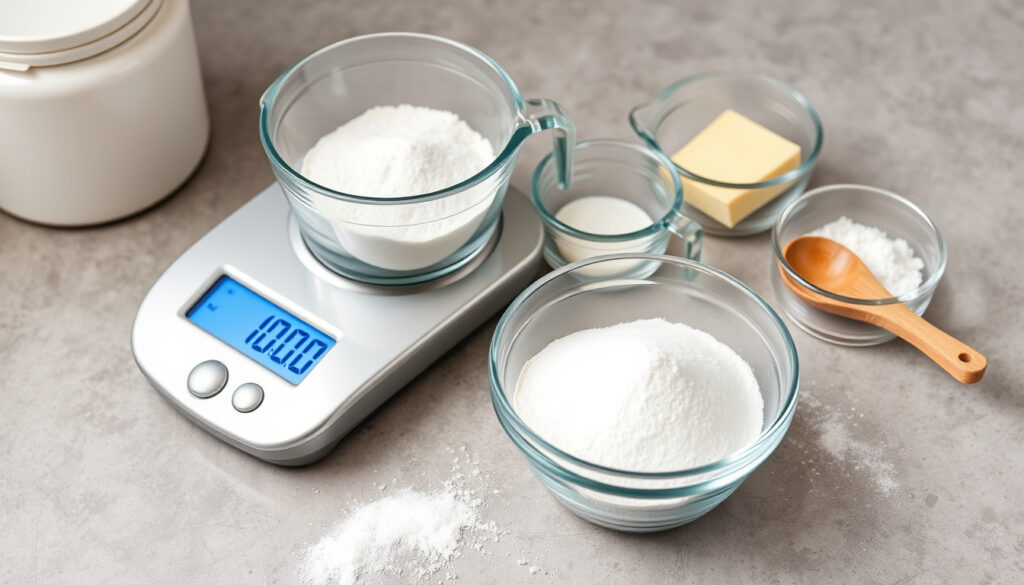
A digital kitchen scale is the gold standard. Place a bowl on the scale, tare it to zero, and add your ingredient until the display reads 100 grams. This bypasses all density confusion. The Calculator Site culinary conversions recommends scales for any baking where precision matters — cookies, cakes, or bread where the flour-to-liquid ratio is critical.
Measuring without a scale: spoons, cups, and visual cues
No scale? Use these ingredient-specific shortcuts backed by standard conversion values. Follow these steps for a reliable approximation:
- Identify the ingredient and look up its grams-per-cup density from a trusted source (e.g., the snapshot block above).
- Calculate the cup value using the formula: 100g ÷ density.
- Select the closest standard measuring cup or spoon combination.
- Use the correct technique: spoon-and-level for flour, scoop-and-level for sugar, cut from a stick for butter.
- All-purpose flour (100g = 0.8 cups): Spoon flour into a 1-cup measure, then remove 2 tablespoons. Or use a 3/4 cup measure and add 2 tablespoons.
- Granulated sugar (100g = 0.5 cups): Scoop a 1/2-cup measure and level with a knife.
- Butter (100g ≈ 7 tablespoons): One standard US stick is 113g (8 tbsp). Cut off slightly less than a full stick — about 7 tablespoons.
- Water (100g = 0.42 cups): Fill a liquid measuring cup to just under 1/2 cup.
The catch: volume-based methods introduce measurement error. Spoon-and-level (fluff flour, spoon into cup, level) gives a lighter cup than scoop-and-pack (dipping the cup into the flour bin). For 100 grams of flour, the difference between these two methods can be 10-15% — enough to affect a delicate cake.
The catch: without a scale, you can approximate 100g using standard cups, but expect a 10-15% error for flour. For consistent baking results, a digital scale is essential.
How much is 100 grams of flour in cups?
Flour is the most common conversion headache because its density varies by type and even by brand. Here’s the breakdown for three popular flours.
All-purpose flour
100g = 0.8 cups (4/5 cup). The Calculator Site conversion guide lists all-purpose flour at 125 grams per cup, making 100 grams exactly 0.8 cups. Doves Farm (UK organic flour producer) places 1 cup at 120 grams, which would make 100g ≈ 0.83 cups — a negligible 3% difference for most home baking.
Whole wheat flour
100g ≈ 0.83 cups. Whole wheat flour is denser than all-purpose due to the bran and germ. Standard conversions place it around 120 grams per cup, so 100 grams yields roughly 0.83 cups. The extra fiber means it absorbs more liquid, so volume-based substitutions from all-purpose flour require recipe adjustments.
Almond flour
100g ≈ 1 cup. Almond flour has a lower density — about 96 grams per cup in most conversion tables. This means 100 grams actually overflows a full cup slightly. For gluten-free and low-carb bakers, this is a critical distinction because almond flour cannot substitute 1:1 by volume with wheat flour.
Why this matters: using a 1-cup measure for 100g of all-purpose flour (expecting 1:1) would over-measure by 25%. For a recipe with 3 cups of flour, that error compounds to 0.6 cups extra — enough to turn a fluffy loaf into a brick.
How can I easily measure 100 grams at home?
When the scale is buried in a cabinet or the battery is dead, household objects can serve as rough calibration tools. These methods are approximations, not laboratory measurements — but they’re better than guessing.
Using household objects: coins, batteries
- US quarters: A single quarter weighs 5.67 grams. Stack 18 quarters for approximately 102 grams — close enough for non-baking kitchen tasks.
- AA battery: One AA battery weighs about 23 grams. Four batteries total about 92 grams; add one more for ~115g.
- US dollar bill: Weighs approximately 1 gram. 100 bills = 100 grams — impractical for cooking, but useful as a conceptual reference.
Coins and batteries are not food-safe. Always wash and dry them thoroughly before using them as counterweights on a balance scale. Never place them on the same surface as open food.
Using measuring cups and spoons
For the most common ingredients, here’s the quickest cup-and-spoon method for reaching 100 grams:
- Sugar (any type): Fill a 1/2 cup measure level = 100g.
- Flour (all-purpose): Fill a 3/4 cup measure + 2 teaspoons = ~100g.
- Butter: Cut 7 tablespoons from a stick (1 stick = 8 tbsp = 113g).
- Honey or syrup: Fill a 1/3 cup measure level = ~100g.
The pattern: once you know the grams-per-cup value for an ingredient, you can work backward to find the closest standard measure. It’s not perfect, but for everyday cooking it reduces error to under 5% — well within acceptable range for soups, sauces, and most baked goods.
Related reading: How Many Grams in a Kilogram? Quick & Exact Guide
padhuskitchen.com, cookconverter.com, cookingconverter.com, bakingscalepro.com, formulafactory.tools
For those needing precise measurements, a detailed 100 grams to cups guide for flour, sugar, butter breaks down the exact conversions for each ingredient.
Frequently asked questions
How many cups is 100 grams of rice?
Uncooked white rice has a density of approximately 190 grams per cup. Therefore, 100 grams of uncooked rice equals roughly 0.53 cups. Cooked rice expands and changes density, so this conversion applies only before cooking. (BBC Good Food conversion guide)
Is 100 grams of butter the same as 1 stick?
No. One standard US stick of butter is 113 grams (8 tablespoons). 100 grams is slightly less than 1 stick — about 7 tablespoons or 0.44 cups.
Can I use a tablespoon to measure 100 grams?
Yes, but the conversion depends on ingredient density. For all-purpose flour (density ~7.8g per tablespoon), you’d need about 13 tablespoons to reach 100 grams. For granulated sugar (~12.5g per tablespoon), 8 tablespoons is enough. A scale is still faster and more accurate.
What is 100 grams of oats in cups?
Rolled oats have a density of about 90 grams per cup. 100 grams of rolled oats equals roughly 1.1 cups — slightly more than a full cup.
Does 100 grams of honey equal 1/3 cup?
Very close. Honey has a density around 340 grams per cup, so 100 grams equals about 0.3 cups — just under 1/3 cup (0.33 cups). A 1/3-cup measure will give you approximately 113 grams of honey, so for 100 grams, fill the 1/3 cup to about 90% full.
How many cups is 100 grams of chocolate chips?
Chocolate chips have a density of approximately 180 grams per cup. 100 grams of chocolate chips equals about 0.56 cups — a scant 1/2 cup plus 1 tablespoon.
Is 100 grams the same as 100 ml?
Only for water at room temperature, where 1 gram of water equals 1 milliliter. For all other ingredients, 100 grams does not equal 100 ml. A liquid measuring cup marked in milliliters cannot accurately measure dry ingredients by weight.
For home cooks without a scale, the choice is clear: memorize the conversion for your three most-used ingredients, use a standard measuring cup set, and accept a small margin of error. For bakers who need consistent results, invest in a $15 digital kitchen scale — it eliminates guesswork and makes 100 grams as simple as pressing tare and pouring.
More related posts
 Galaxy Note 2 to Buy: Complete 2024 Guide with Prices
 Club Brugge v FC Barcelona Lineup : MOTM, Yamal, 1:1 Rule
 Where Is the Liver Located? Anatomy, Pain & Functions
 University of New Hampshire: Rankings, Majors, Admissions & More
 How to Screenshot on Windows: Keyboard Shortcuts & Fixes
 Cast of Kinda Pregnant (2025): Full List & Characters
 Colt v Seahawk Match Player Stat : Final Stat and Key Performance
 Difference Between Affect and Effect – Rules and Examples