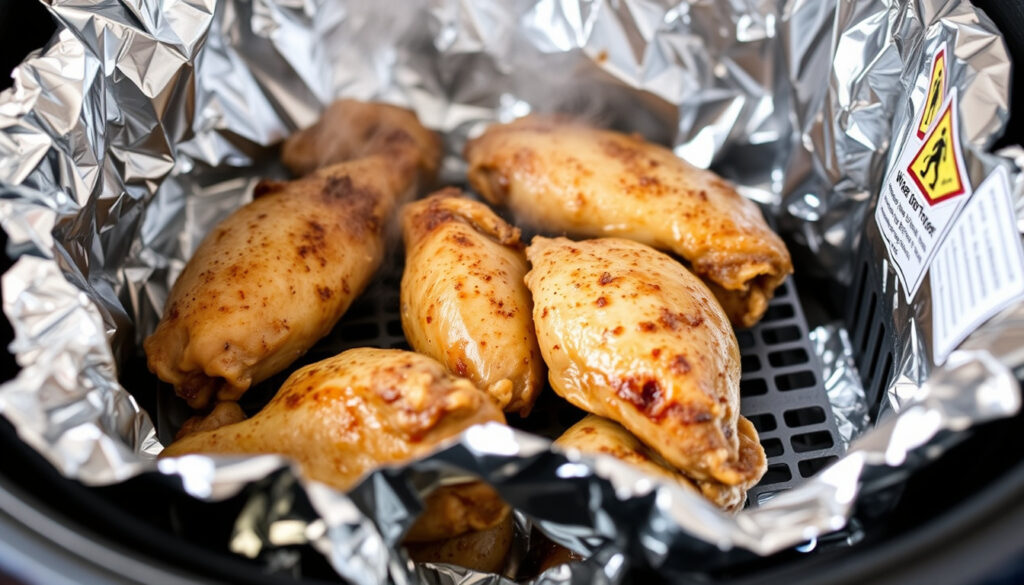
Can You Put Aluminum Foil in an Air Fryer? Safety Tips
If you’ve just unboxed an air fryer humming with promises of crispy fries, the urge to line that basket with aluminum foil is almost automatic — easier cleanup, fewer scrubbing sessions. But between the rapid fan and the heating coil, foil behaves differently than it does in a regular oven.
Air fryer max temperature: 400°F (200°C) ·
Aluminum foil melting point: 1,220°F (660°C) ·
Safe foil usage rule: Never let foil touch heating element ·
Parchment paper heat tolerance: 425°F (218°C)
Quick snapshot
- Foil must be weighted down with food to prevent blowing around (Running to the Kitchen (cooking blog))
- Parchment paper can handle temperatures up to 425°F (KitchenAid (appliance manufacturer))
- Foil is safe if it never touches the heating element) (Running to the Kitchen (cooking blog))
- Long-term health effects of aluminum ingestion from cooking foil are not fully established (Running to the Kitchen (cooking blog))
- Whether foil leaches significant amounts into all foods at air fryer temperatures (Running to the Kitchen (cooking blog))
- Not applicable — no timeline data available for this topic
- Check your air fryer manual for specific foil guidelines
- Consider switching to parchment paper for health and crispiness)
Four key facts tell the story of foil safety in air fryers:
| Label | Value |
|---|---|
| Air fryer max temp | 400°F (200°C) |
| Foil melting point | 1,220°F (660°C) |
| Safe to use? | Yes, with three rules |
| Foil vs parchment preference | Parchment recommended for crispiness and health |
Is it safe to put aluminum foil in the air fryer?
What are the three rules for safe foil use?
- Rule one: Never let foil touch the heating element. Air fryers typically reach 400°F (200°C), while foil’s melting point is 1,220°F (660°C), so melting isn’t the worry — blocking airflow is. According to Running to the Kitchen (cooking blog), foil that touches the element can disrupt hot air circulation and ruin cooking performance.
- Rule two: Weight the foil down with food. The air fryer’s fan circulates air at high speed. Unweighted foil can lift and fly into the heating element, creating a fire hazard. Running to the Kitchen emphasizes this as a non-negotiable safety step.
- Rule three: Do not cover all holes in the basket. Air fryers rely on perforated baskets for proper airflow. Blocking all openings with foil essentially turns the air fryer into a still oven — resulting in uneven, mushy food, as noted by Running to the Kitchen (cooking blog).
Can foil touch the heating element?
No. KitchenAid (appliance manufacturer) explicitly advises against any foil contact with heating elements. Foil touching the coil can cause sparking, melting (if temperatures spike), and permanent airflow disruption. Even a small folded-over corner that contacts the element compromises safety.
The catch: Most accident reports come from people wedging foil into the basket bottom — that’s where it contacts the heating assembly. If you must use foil, tuck it only inside the basket walls, not the base.
Does covering all basket holes cause problems?
Yes — and it’s one of the top mistakes cited by manufacturers. Whirlpool (appliance manufacturer) states that covering all holes blocks the rapid hot air circulation, which is the entire point of air frying. Food comes out steamed rather than crispy. Damage to the appliance’s heating mechanism can also occur over repeated uses.
Why this matters: The “three-rule” system isn’t arbitrary — it directly maps to how air fryers work. Air flows bottom-to-top through basket holes, across the food, and back down around the sides. Foil that blocks any part of this loop breaks the cooking cycle.
Foil offers easier cleanup, but each safety rule constrains its usefulness. By following all three, you get convenience without damaging your appliance — but you also give up the crispiness that parchment paper can deliver.
The implication: Adhering to the three rules allows foil to be used safely without damaging the appliance or compromising food quality, but any deviation introduces risk.
Is it better to put aluminum foil or parchment paper in the air fryer?
When should you use aluminum foil?
- Trapping moisture: Wrapping meats in foil for chicken or fish locks in juices. Foil acts as a steaming pouch — ideal for tender results, as Running to the Kitchen (cooking blog) notes.
- Drip-catching in oven air fry modes: Whirlpool (appliance manufacturer) says foil-lined baking sheets can sit on lower racks in ranges with air fry mode — just maintain airflow space above.
- Quick cleanup: Foil catches drips and greasy residue, reducing scrubbing time. But only if positioned correctly — never at the basket’s bottom where holes are blocked.
When should you use parchment paper?
- Better airflow: KitchenAid (appliance manufacturer) recommends parchment paper for range air fry modes because it allows some air penetration while providing a non-stick surface. In basket air fryers, pre-cut parchment liners with perforations maintain airflow.
- Non-stick without reactivity: Parchment is inert — it won’t react with acidic foods like foil does. Running to the Kitchen advises avoiding foil with vinegar-based marinades.
- Health-conscious choice: Parchment has no aluminum leaching concerns — a factor at high temperatures.
Which option is healthier?
Parchment paper is the healthier choice. Aluminum foil can leach into food — especially acidic foods like tomatoes, citrus, or vinegar marinades — and the leaching increases at higher temperatures. Running to the Kitchen (cooking blog) flags this as a reason to prefer parchment for acidic ingredients.
Three points of comparison, one clear pattern: parchment paper wins for crispiness and health, foil wins for moisture-trapping and ease of wrapping.
| Feature | Aluminum foil | Parchment paper |
|---|---|---|
| Airflow in basket | Poor — blocks holes easily | Better — DIY punch holes or use pre-cut |
| Non-stick | Good (non-stick side) | Excellent (natural non-stick) |
| Best for | Wrapping chicken, fish, trapping moisture (Running to the Kitchen) | Crispy fries, vegetables, baked goods (KitchenAid) |
| Health concern | Aluminum leaching with acidic foods at high heat (Running to the Kitchen) | No leaching, food-safe up to 425°F (KitchenAid) |
| Temperature limit | 1,220°F (660°C) — well above air fryer max | 425°F (218°C) — safe for all air fryers |
| Cleanup | Excellent (catch drips, then discard) | Good (discard, but may tear with heavy grease) (Whirlpool) |
Upsides
- Foil: easy cleanup, traps moisture, high heat tolerance
- Parchment: better airflow, non-stick, no health concern
Downsides
- Foil: blocks airflow, can leach aluminum, not for acidic foods
- Parchment: lower temperature limit, may tear with heavy grease
What should you not put in an air fryer?
What foods should never go in an air fryer?
- Lightweight foods that fly up: Loose bread slices, lettuce, or spinach can blow around and contact the heating element. Running to the Kitchen (cooking blog) warns against anything that isn’t anchored by weight.
- Wet batters: Tempura or beer batter drips through the basket holes and creates smoke, mess, and potential fire risk. Better to dry-bread first, as KitchenAid advises.
- Large whole cuts of meat: Bone-in roasts or whole chickens may not fit properly, blocking airflow and cooking unevenly.
What materials are unsafe?
- Standard plastic wrap: Melts at air fryer temperatures. Only use oven-safe silicone or designated air fryer accessories.
- Thin paper plates: Can catch fire. Whirlpool (appliance manufacturer) recommends only parchment paper or foil as baking materials.
- Foil at the basket bottom: The most common unsafe practice — foil covering the entire basket base blocks all air circulation, as Running to the Kitchen (cooking blog) notes.
The implication: Most unsafe items share one quality — they disrupt or block the air flow path that air fryers depend on. If it can fly, drip, or cover holes, it doesn’t belong.
What are common mistakes when using air fryers?
How does overcrowding affect cooking?
Overcrowding is the number-one mistake for new owners. When too much food fills the basket, air can’t circulate around each piece. Results: soggy food, extended cook times (often 30-50% longer), and uneven browning. KitchenAid (appliance manufacturer) recommends cooking in single layers for optimal crispiness — even if that means cooking in batches.
Why should you preheat the air fryer?
Skipping preheating leads to longer cook times and uneven results. Air fryers need 3-5 minutes to reach temperature, just like ovens. Whirlpool (appliance manufacturer) suggests preheating empty (without foil) for even temperature distribution.
What happens if you use too much oil?
Excess oil creates smoke, and in some cases can drip onto the heating element and cause burning. Air fryers work with minimal oil — 1-2 teaspoons is usually enough for a full basket. Running to the Kitchen (cooking blog) notes that oil-spray cans (aerosol) can damage non-stick coatings; a pump sprayer or brush is better.
The trade-off: Air fryers promise convenience, but that convenience collapses if you skip preheating, overcrowd, or over-oil. The foil question is just one variable in a system that rewards attention to basics.
Is it unhealthy to use aluminum foil in an air fryer?
Does aluminum leach into food?
Yes — aluminum can migrate into food, especially when exposed to acidic ingredients like tomato sauce, citrus juice, or vinegar-based marinades. Running to the Kitchen (cooking blog) explicitly advises against using foil with acidic foods in the air fryer. At typical air fryer temperatures of 350-400°F (175-200°C), leaching may be accelerated compared to room temperature storage.
Are there safer alternatives?
Parchment paper is the non-reactive alternative. It’s food-safe up to 425°F (218°C) — well within air fryer range — and won’t interact chemically with any food type. KitchenAid (appliance manufacturer) recommends parchment for range air fry modes, while pre-cut perforated parchment liners work for basket-style air fryers.
The uncertainty: The long-term health effects of aluminum ingestion from routine cooking foil use are not fully established by scientific bodies. In the US, the Agency for Toxic Substances and Disease Registry (ATSDR) notes that most aluminum consumed passes through without absorption — but chronic, high-exposure scenarios remain debated. For cautious home cooks, parchment paper eliminates the variable entirely.
Why this matters: The health question splits users into two camps. For occasional foil use (once a week or less) with non-acidic foods, the risk appears minimal. For daily or acidic food preparation, parchment paper is the prudent move.
Expert quotes on foil safety
“Aluminum foil can be used in basket air fryers as long as it is weighed down by food and does not touch the heating element or cover all basket holes.”
Running to the Kitchen (cooking blog)
“KitchenAid advises against using aluminum foil in countertop air fryers or ovens with air fry due to airflow interference.”
KitchenAid (appliance manufacturer)
“Whirlpool states aluminum foil cannot be used in standalone air fryers but is okay in ranges with air fry mode on lower racks.”
Whirlpool (appliance manufacturer)
“Foil in air fryers can disrupt rapid hot air circulation, preventing even cooking.”
KitchenAid (appliance manufacturer)
Summary
Aluminum foil in an air fryer is safe if — and only if — you follow the three rules: keep it off the heating element, weight it down with food, and never cover all basket holes. Parchment paper, however, delivers better crispiness and eliminates any aluminum health concerns. For the home cook who reaches for the air fryer three times a week, the choice is clear: save foil for wrapping chicken or fish, and use parchment paper liners for the everyday fries, vegetables, and reheat jobs where crunch matters most.
Frequently asked questions
Can you put aluminum foil in an air fryer Power XL?
Yes, you can put aluminum foil in a Power XL air fryer as long as you follow the three safety rules: keep foil away from the heating element, weigh it down with food, and avoid covering all basket holes. Always check your specific Power XL model manual for any additional warnings.
Can you line the bottom of an air fryer with foil?
No — do not line the bottom of a basket air fryer with foil. Placing foil on the bottom beneath the basket blocks airflow and can cause uneven cooking or appliance damage, as noted by Running to the Kitchen (cooking blog).
Does aluminum foil affect cooking time in an air fryer?
Yes, foil can affect cooking time. If foil partially blocks airflow, food may take longer to cook. When using foil as a liner or wrap, monitor cooking progress and add 2-5 minutes if needed, since hot air circulation is slightly reduced.
Can you use foil to catch drips in an air fryer?
In basket-style air fryers, avoid placing foil at the bottom to catch drips — it blocks airflow. However, in oven-style ranges with an air fry mode, you can place a foil-lined baking sheet on a lower rack to catch drips while maintaining airflow space. Whirlpool (appliance manufacturer) confirms this as acceptable practice.
Is it better to use foil or parchment paper for chicken in an air fryer?
Use foil if you want moist, tender chicken with captured juices — wrap the chicken loosely in foil. Use parchment paper for chicken with crispy skin (unwrapped chicken). Both methods work; the choice depends on whether you prioritize juiciness or crunch.
Can you put foil in an air fryer basket without holes?
Air fryer baskets without holes (solid pans) are less common, typically found in oven-style units. Foil is generally acceptable on solid surfaces, as airflow isn’t blocked by the foil itself. However, the air fry mode still requires space around the foil-covered item for air to circulate.
What happens if foil touches the heating element in an air fryer?
Foil touching the heating element can cause sparking, melting, damage to the heating coil, and present a fire hazard. KitchenAid (appliance manufacturer) explicitly advises against any contact between foil and the heating element. If this happens, unplug the unit immediately.
Can you wrap chicken in foil in an air fryer?
Yes, wrapping chicken in foil is safe and effective. It traps moisture and juices, resulting in tender meat. Use a “packet” style — place the chicken in the center, fold the foil edges over, and leave some space for steam circulation. Ensure the packet doesn’t touch the heating element and is weighted down (the chicken itself provides the weight).
More related posts
 Cast of Kinda Pregnant (2025): Full List & Characters
 To All the Boys I Loved Before – Trilogy Watch Order Guide
 What Is a Function? Definition, Types & Math Examples
 Man o’ War Jellyfish – Size, Sting Facts and Beach Safety
 Can Cats Have Blueberries – Vet Guide to Safety and Benefits
 Free Reverse Phone Lookup Tools That Actually Work
 Emily in Paris Cast – Full Actors List and Season 4 Updates
 10 kg to lbs: Convert 10 Kilograms to Pounds (Exact)