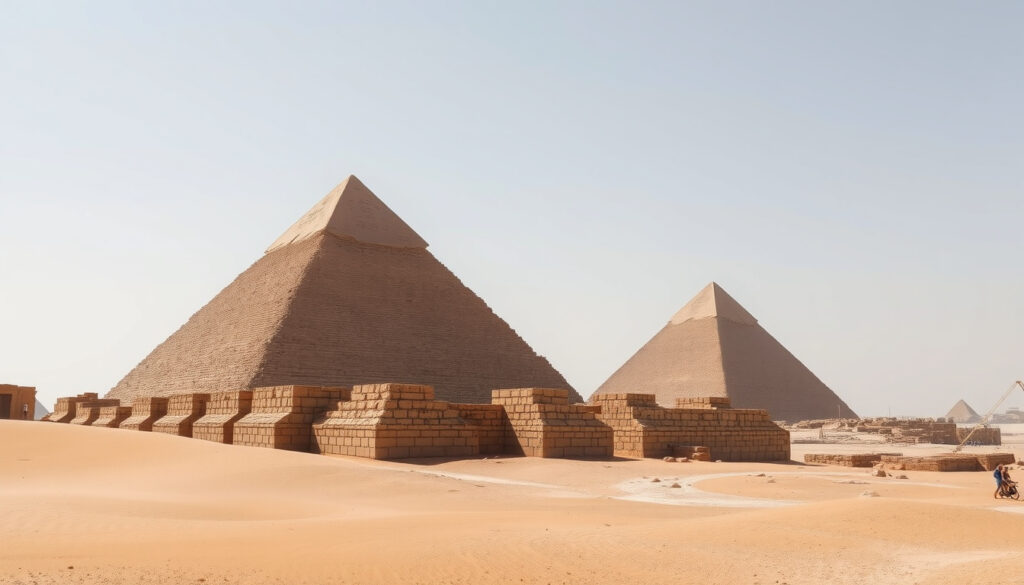
When Were the Pyramids Built? Timeline, Age, and History
Anyone who’s ever seen a photo of the Giza Pyramids has probably wondered: how old are they really? The answer, confirmed by archaeologists, places their construction around 4,500 years ago during Egypt’s Old Kingdom.
Earliest major pyramid: Pyramid of Djoser, c. 2630–2610 BC ·
Giza Pyramids construction period: 2589–2504 BC (approx. 85 years) ·
Age of Giza Pyramids today: About 4,500 years ·
Oldest known pyramid: Pyramid of Djoser (Step Pyramid) ·
Number of major pyramids in Egypt: Over 100
Quick snapshot
- Pyramid of Djoser built c. 2630–2610 BC (Smithsonian Institution (museum and research))
- Giza Pyramids built 2589–2504 BC over 85 years (AERA (archaeological research team))
- Great Pyramid of Khufu is about 4,600 years old (National Geographic (editorial publication))
- Exact year of start of construction for the Great Pyramid remains debated
- Why alternative dates (e.g., 10,000-year claims) persist without evidence
- Whether Jesus ever visited Egypt – not recorded in historical sources
- Unification of Egypt c. 3100 BC (Wikipedia (community-edited encyclopedia))
- Step Pyramid built c. 2630–2610 BC (Smithsonian Institution)
- Giza complex built 2589–2504 BC (AERA)
- Last major pyramid c. 1700 BC (Wikipedia)
- Ongoing radiocarbon dating of mortar may refine exact dates
- Public interest in pyramid age comparisons continues to drive searches
Five key facts, one pattern: the entire era of pyramid building spans roughly 1,000 years, with the Giza complex representing the peak of Old Kingdom engineering.
| Fact | Value |
|---|---|
| Oldest Egyptian pyramid | Pyramid of Djoser (c. 2630 BC) |
| Giza Great Pyramid builder | Pharaoh Khufu (c. 2589–2566 BC) |
| Total construction period for Giza | 85 years (2589–2504 BC) |
| Age of pyramids at Jesus’ birth | Approximately 2500 years old |
| Pyramids vs. Stonehenge | Stonehenge older by at least 600 years |
| Number of major pyramids in Egypt | Over 100 |
The implication: The pyramids are surprisingly young compared to Stonehenge but already ancient to Jesus and Cleopatra.
When were the pyramids built in Egypt?
The Egyptian pyramids were built during the Old and Middle Kingdom periods, roughly from the 27th to the 17th century BC. The earliest known pyramid, the Step Pyramid of Djoser, dates to around 2630–2610 BC according to the Smithsonian Institution (U.S. national museum). The transition to true smooth-sided pyramids came under Pharaoh Snefru, founder of the Fourth Dynasty.
Earliest pyramids: the Step Pyramid of Djoser
- Architect Imhotep designed the Step Pyramid by stacking six mastabas (Smithsonian Institution).
- Construction date: c. 2630–2610 BC (some sources give 2780 BC – see Smithsonian).
- The pyramid originally stood 62 meters high and is located at Saqqara.
The Giza pyramid complex construction era
- The Giza Pyramids were built over 85 years, between 2589 and 2504 BC, according to AERA (Ancient Egypt Research Associates).
- The Great Pyramid of Khufu (Cheops) is the largest, originally 146.6 meters tall (Encyclopaedia Britannica (reference publisher)).
- National Geographic places Khufu’s start around 2550 BC (National Geographic).
When did pyramid building end in ancient Egypt?
- The last major pyramid was built during the Middle Kingdom, around 1700 BC (Wikipedia (community-edited encyclopedia)).
- Later pharaohs built smaller, less durable pyramids, often of mudbrick.
Why this matters: Knowing the exact construction window helps debunk modern myths about the pyramids being tens of thousands of years old.
Did Egypt exist 5000 years ago?
Yes, Egypt existed as a unified state 5,000 years ago (around 3000 BC). The unification of Upper and Lower Egypt is traditionally credited to King Narmer (Menes) around 3100 BC.
What was Egypt like around 3000 BC?
- Egypt was already a sophisticated civilization with a centralized government, writing, and monumental architecture.
- The first pharaohs ruled from Memphis, near modern Cairo.
- Archaeological evidence from the Smithsonian Institution confirms the existence of early dynastic tombs and hieroglyphic inscriptions.
The unification of Upper and Lower Egypt
- The Narmer Palette, dated to c. 3100 BC, depicts the unification (Wikipedia).
- This event marks the beginning of the Dynastic Period.
The pattern: By 3000 BC, Egypt was a fully formed state – more than 400 years before the first pyramid.
Is Stonehenge older than the pyramids?
Yes, Stonehenge is older than the Egyptian pyramids. The earliest phase of Stonehenge dates to around 3100 BC, while the Giza Pyramids were built around 2500 BC.
When was Stonehenge built?
- Stonehenge’s construction began c. 3100 BC with a circular ditch and bank (Wikipedia).
- The famous stone circle was erected around 2500 BC, roughly contemporary with the Giza Pyramids.
- Radiocarbon dating places the earliest features at 3100 BC (National Geographic).
Which is older: Stonehenge or the pyramids?
- Stonehenge predates the Giza Pyramids by about 600 years.
- However, the Step Pyramid of Djoser (c. 2630 BC) is closer in age to Stonehenge’s later phases.
Stonehenge is older than the pyramids, yet it was built by a pre-literate society with no centralized state. The pyramids required a highly organized bureaucracy and pharaonic power.
The implication: The pyramids are not the oldest large stone structures on Earth – Stonehenge holds that title among well-known monuments.
How old were the pyramids when Jesus was born?
When Jesus was born around 4–6 BC, the Giza Pyramids were already approximately 2,500 years old – older than the birth of Jesus is to us today.
Dating the birth of Jesus
- Most scholars place Jesus’ birth between 6 and 4 BC (Encyclopaedia Britannica).
- The traditional date of 1 AD is based on a 6th-century calculation now known to be off by a few years.
Pyramids age at the time of Jesus
- The Great Pyramid was completed around 2560 BC. By 4 BC, that is 2,556 years old.
- So the pyramids were already ancient when Jesus walked the Earth.
What this means: The pyramids were as old to Jesus as the fall of the Roman Empire is to us.
When were the pyramids built compared to Cleopatra?
Cleopatra lived from 69 to 30 BC, more than 2,000 years after the Giza Pyramids were built. The gap between the pyramid builders and Cleopatra is larger than the gap between Cleopatra and the present day.
Cleopatra’s timeline (69–30 BC)
- Cleopatra VII ruled Egypt as the last Ptolemaic pharaoh (Encyclopaedia Britannica).
- She lived nearly 2,500 years after the Step Pyramid was built.
Time gap between pyramid construction and Cleopatra
- Giza Pyramids: c. 2500 BC.
- Cleopatra: 69–30 BC. Difference: about 2,430 years.
- That’s roughly the same time span as from Cleopatra to today.
Cleopatra lived closer to the invention of the iPhone than to the building of the Great Pyramid. The pyramids were already weathered monuments when she visited them.
The trade-off: The pyramids are often used as a reference for ancient Egypt, but Cleopatra’s era was separated from them by millennia.
Are the pyramids 10,000 years old?
No. There is no credible archaeological evidence supporting the claim that the Egyptian pyramids are 10,000 years old. The oldest known pyramids date to about 4,600 years ago.
Evidence against 10,000-year-old pyramids
- Radiocarbon dating of organic material in pyramid mortar gives consistent dates around 4,500 years ago (Wikipedia).
- Archaeological context from the Old Kingdom (c. 2686–2181 BC) places the pyramids firmly in the 3rd millennium BC (PBS NOVA (science documentary)).
- Geological evidence shows no signs of erosion or site formation consistent with a 10,000-year age.
What is the oldest known civilization?
- Göbekli Tepe in Turkey dates to around 9500 BC, far older than any pyramid claim (National Geographic).
- Mesopotamian civilizations (Sumer) date to around 4000 BC.
- Egyptian civilization began around 3100 BC.
The catch: The 10,000-year pyramid myth often arises from misinterpretations of water erosion or pseudoscientific theories. Academic consensus firmly rejects it.
Timeline signal
- – Unification of Egypt under first pharaohs (Wikipedia)
- – Earliest phase of Stonehenge built (Wikipedia)
- – Pyramid of Djoser (Step Pyramid) built (Smithsonian Institution)
- – Giza Pyramids constructed (Khufu, Khafre, Menkaure) (AERA)
- – Last major Egyptian pyramid built (Wikipedia)
- – Traditional date for birth of Jesus; pyramids already ~2500 years old (Encyclopaedia Britannica)
- – Life of Cleopatra; pyramids over 2000 years old at her time (Encyclopaedia Britannica)
- – Present day: pyramids are approximately 4500 years old (AERA)
The timeline confirms the pyramid era spanned roughly 1,000 years, with Giza as the peak.
Clarity section
Confirmed facts
- Pyramid of Djoser built c. 2630–2610 BC (Smithsonian Institution)
- Giza Pyramids built during the 4th Dynasty, c. 2589–2504 BC (AERA)
- Egypt existed as a unified state by 3100 BC (Wikipedia)
What’s unclear
- Exact year of beginning of construction for the Great Pyramid
- Why some alternative dates (e.g., 10,000-year claim) persist without evidence
- Whether Jesus ever visited Egypt (not recorded in historical sources)
These confirmed facts and open questions frame the current understanding of pyramid chronology.
Key perspectives
The Giza pyramids were built over a span of 85 years, between 2589 and 2504 BCE.
AERA (Ancient Egypt Research Associates)
The Step Pyramid was built around 2780 BCE by Imhotep for King Djoser.
Smithsonian Institution
The Great Pyramid of Giza is about 4,600 years old.
National Geographic
These perspectives from authoritative sources reinforce the established timeline.
The pyramids are not the world’s oldest monuments, but they are the most enduring symbols of ancient Egyptian civilization. For the curious reader, the takeaway is clear: the pyramids were built roughly 4,500 years ago, during the Old Kingdom, and they were already ancient by the time of Jesus and Cleopatra. For anyone encountering fringe claims about 10,000-year-old pyramids, the evidence is unequivocal: the archaeological and radiocarbon record places them firmly in the third millennium BC. For the modern traveler or history enthusiast, the pyramids remain a tangible link to a civilization that flourished 4,500 years ago – and that’s impressive enough without needing to invent a longer past.
Related reading: **The Great Wave off Kanagawa: History, Meaning, and Value**
en.wikipedia.org, globaldatabase.ecpat.org, imba.missouri.edu, explore.st-aug.edu, scribd.com, pbs.org
Frequently asked questions
Why were the pyramids built?
Pyramids served as royal tombs for pharaohs, designed to protect the king’s body and possessions for the afterlife. They were part of a larger mortuary complex.
Who built the pyramids of Giza?
The Giza Pyramids were built by thousands of skilled laborers, not slaves. They were organized by the pharaohs Khufu, Khafre, and Menkaure of the Fourth Dynasty.
How long did it take to build the Great Pyramid?
Estimates range from 10 to 20 years, based on the scale and workforce size. The entire Giza complex took 85 years to complete.
Is it true the pyramids are 10,000 years old?
No. Archaeological evidence consistently dates the pyramids to around 4,500 years ago. Claims of 10,000 years are not supported by any credible research.
What is the oldest pyramid in Egypt?
The Step Pyramid of Djoser at Saqqara, built c. 2630–2610 BC, is the oldest known pyramid in Egypt.
Did the pyramids exist when Jesus was alive?
Yes. The pyramids were already about 2,500 years old at the time of Jesus’ birth. They were ancient ruins in his era.
What does the Bible say about the pyramids?
The Bible does not mention the Egyptian pyramids by name. Some references to “store cities” like Pithom and Raamses (Exodus 1:11) are not related to pyramids.
These FAQs address the most common questions about pyramid chronology and myths.
More related posts
 Is the Government Shut Down? Status, Duration & Impact
 To All the Boys I Loved Before – Trilogy Watch Order Guide
 Ruth and Boaz Movie: Cast, Plot, Reviews, Biblical Connection
 Have I Been Pwned: Check Emails & See If You’ve Been Hacked
 Five Nights at Freddy’s: Safe for Kids? Age Rating & Story Guide
 USA Men’s Hockey Next Game: Semifinal vs Slovakia, Feb. 20, 2026
 Is Presidents Day a Federal Holiday? 2026 Facts and Guide
 All Inclusive Resorts Puerto Rico: Costs & Comparisons