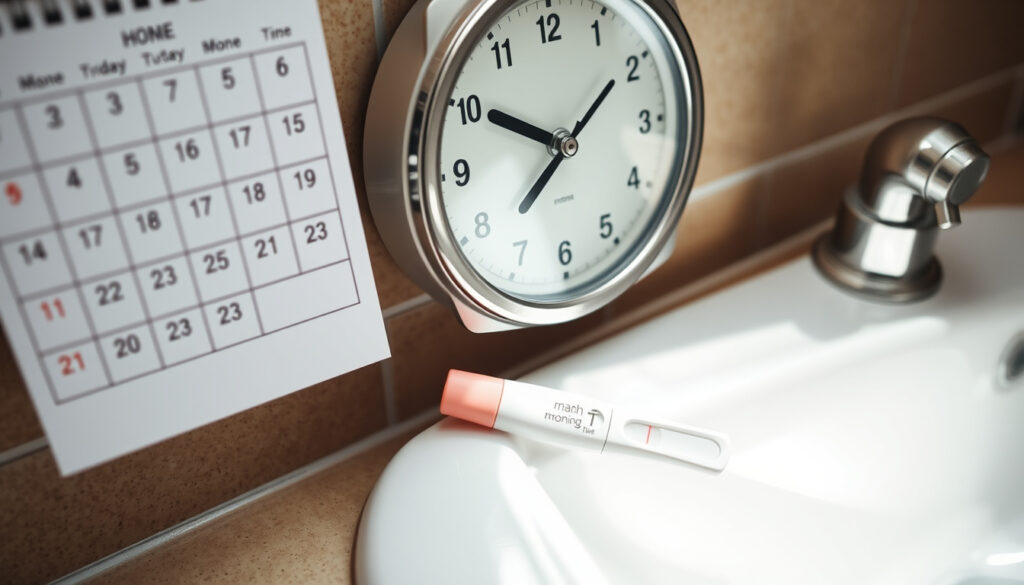
When Can I Take a Pregnancy Test? Timing & Accuracy Guide
You’ve missed a period, or maybe you’re just a few days past ovulation and wondering. The urge to pee on a stick can be overwhelming, but timing matters more than the brand you pick. The simple answer: wait until the first day of your missed period for near‑certain results, but some tests can give you a hint days earlier — with a trade‑off in accuracy.
Accuracy on day of missed period: 99% ·
Earliest detection before missed period (sensitive tests): 6 days ·
Typical hCG threshold for home tests: 25 mIU/mL ·
Time for hCG to double in early pregnancy: 48–72 hours ·
Days after conception when hCG appears in urine: 12–14 days
Quick snapshot
- First day of missed period for standard tests (First Response (test manufacturer))
- Up to 6 days before missed period with early detection tests (Clearblue (test manufacturer))
- Wait at least 21 days after unprotected sex if cycles irregular (NHS 111 Wales (UK public health service))
- Sensitive tests detect hCG at 10 mIU/mL vs standard 25 mIU/mL (Clearblue)
- Implantation must occur before hCG rises (Cleveland Clinic (academic medical center))
- False negatives more likely before missed period (Cleveland Clinic)
- Testing too early is the most common cause (Cleveland Clinic)
- Diluted urine can reduce hCG concentration (Gloucestershire Hospitals NHS Trust (clinical pathology))
- Always re-test after 48–72 hours if period absent (Healthline (health information publisher))
- Input cycle length and ovulation day if known
- Provides window for earliest and most accurate test dates
- Adjusts for irregular cycles via average length
Five key facts about pregnancy test timing, drawn from medical guidelines and manufacturer data:
| Fact | Value |
|---|---|
| Accuracy on missed period day | 99% |
| Earliest detection before missed period | 6 days |
| Typical hCG threshold | 25 mIU/mL |
| hCG doubling time | 48–72 hours |
| Implantation window | 6–12 days after ovulation |
How early can a pregnancy test show positive results?
The answer depends on when your body starts producing hCG after implantation. Most home tests are designed to detect hCG at levels around 25 mIU/mL, which typically occurs by the first day of a missed period.
Understanding hCG levels
- Human chorionic gonadotropin (hCG) is produced by cells that form the placenta after implantation (Cleveland Clinic (academic medical center)).
- Blood tests can detect hCG about 11 days after conception, while urine tests may take 12–14 days (Cleveland Clinic).
Early detection tests vs standard tests
- Some tests, like Clearblue’s “early detection” version, claim to show results up to 6 days before a missed period by detecting hCG as low as 10 mIU/mL (Clearblue).
- Standard tests stick to the 25 mIU/mL threshold and are labeled for use on the first day of a missed period (NUPAS (UK sexual health provider)).
- First Response states its tests are 99% accurate when taken on the expected period day (First Response).
Timeline from conception to detectable hCG
- Conception: Day 0.
- Implantation: Day 6–12 after ovulation (Cleveland Clinic).
The implication: even the most sensitive test can’t turn positive until implantation happens, which varies from cycle to cycle.
Can I be pregnant and still test negative?
Yes — a negative test does not always mean you are not pregnant. Early testing, diluted urine, and irregular cycles all contribute to false negatives.
Reasons for false negative results
- Testing too early is the most common cause. hCG may be below the test’s detection threshold (Cleveland Clinic).
- Diluted urine — for example, after drinking a lot of fluids — can lower hCG concentration (Gloucestershire Hospitals NHS Trust (clinical pathology)).
- Irregular cycles make it harder to know when a period is actually “missed,” so the test may be taken too soon (Chelsea and Westminster Hospital NHS Trust (UK hospital service)).
Timing and hCG thresholds
Standard home tests require about 25 mIU/mL of hCG. If your hCG level is only 10 mIU/mL, the test will show negative even though pregnancy is established. That gap can last a day or two.
What to do after a negative test
- If your period hasn’t started within a few days, re-test (Healthline).
- Contact a healthcare provider if your period is more than a week late and tests remain negative (NUPAS).
The pattern: a single negative test is inconclusive when taken before or just after a missed period. Time and a second test are the only reliable arbiters.
A false negative can delay prenatal care or cause unnecessary anxiety. The risk is highest when you test too early with a standard‑sensitivity test. Waiting 48–72 hours dramatically cuts that risk.
How many days after conception can a pregnancy test detect hCG?
Conception and implantation are separate events. hCG only appears after implantation, so test timing must account for both steps.
Conception to implantation timeline
- Fertilization happens within 24 hours of ovulation.
- The embryo travels to the uterus and implants 6–12 days later (Cleveland Clinic).
- hCG production starts immediately after implantation and doubles every 48–72 hours (First Response).
hCG doubling rate
The rapid doubling means that a test taken two days after the first positive can show a much stronger line. That also explains why waiting a few days turns a faint positive into an obvious one.
Test sensitivity comparison
- Highly sensitive tests (10 mIU/mL threshold) can detect pregnancy about 12–14 days after conception.
- Standard tests (25 mIU/mL threshold) typically turn positive 14–16 days after conception — around the time of a missed period.
The catch: even with a sensitive test, if implantation happens on the late side (day 12), you may still get a negative at 13 days post‑conception.
Testing earlier than 12 days after conception gives you a negative 99% of the time — not because you’re not pregnant, but because hCG hasn’t risen enough. The wait is frustrating but necessary for a reliable result.
When should I take a pregnancy test based on my cycle?
Your cycle length determines the earliest reliable test date. A 28‑day cycle is the textbook pattern, but many people have shorter, longer, or unpredictable cycles.
Calculating your expected period date
- For a regular 28‑day cycle, ovulation occurs around day 14, and the missed period is day 28. Test on day 28 for best accuracy (NUPAS).
- For longer cycles (e.g., 35 days), add the difference: test around day 35.
Using a pregnancy test calculator
- Online calculators ask for cycle length and ovulation day (if known).
- They produce a “first test date” and a “most accurate test date.”
Adjusting for irregular cycles
- NHS guidelines advise waiting at least 21 days after the last instance of unprotected sex if you don’t know your next period date (NHS 111 Wales (UK public health guidance)).
- This 21‑day rule covers the risk of late ovulation that can extend the cycle well past the average.
What this means: if your cycles come every 35–40 days, ignore the “day 14” rule. Anchor your testing to either your own pattern or the 21‑day post‑sex safety net.
What is the best time of day to take a pregnancy test?
Urine concentration directly affects hCG detectability. The simple rule: use first‑morning urine for the strongest signal.
Morning urine concentration
- After a night of sleep, urine is concentrated, making hCG levels easier to detect (Gloucestershire Hospitals NHS Trust (clinical pathology)).
- Studies from Clearblue also recommend morning urine when testing before a missed period (Clearblue (test manufacturer)).
Hydration effects
- Drinking large amounts of fluid before a test can dilute hCG and cause a false negative (Healthline).
- If you test later in the day, hold urine for at least 4 hours and avoid excessive fluid intake.
Following test instructions
- Each brand has specific steps: immerse the stick for 5 seconds, lay it flat, and read within 3–5 minutes (First Response).
- Reading too early or too late can produce ambiguous results.
The pattern: morning urine is the safe default. If you must test later, use a sensitive early‑detection test and restrict fluids for a few hours beforehand.
How to Take a Pregnancy Test for Accuracy
Follow these steps to minimize errors and get the clearest result:
- Check the expiration date. Expired tests may give false results.
- Use first‑morning urine if testing before a missed period (Clearblue).
- Read the package insert for your specific brand’s instructions (First Response).
- Urinate into a clean cup and dip the test strip for the recommended time, or hold the stick in the urine stream if indicated.
- Place the test on a flat surface and wait the exact reading window (typically 3–5 minutes).
- Interpret the result: one line is negative, two lines is positive. Digital tests display “pregnant” or “not pregnant.”
- If negative but your period still hasn’t started, repeat the test 48–72 hours later (Cleveland Clinic).
The implication: following the same routine each time eliminates variables that could cloud the result.
Timeline from Conception to Positive Test
- Day 0: Conception (fertilization).
- Day 6–12: Implantation (Cleveland Clinic).
- Day 11–14: hCG detectable in blood (Cleveland Clinic).
- Day 12–14: hCG detectable in urine with sensitive tests (Clearblue).
- Day 14–16: Missed period.
- Day 14+: Standard home test turns positive (NUPAS).
The earliest reliable positive window is day 12–14 after conception if using an ultra‑sensitive test. For the 99% certainty manufacturers promise, wait until the missed period — around day 14–16.
What We Know and What Remains Unclear
Confirmed facts
- Home tests are about 99% accurate when used correctly after the missed period (First Response).
- hCG rises rapidly after implantation, doubling every 48–72 hours (First Response).
- Early testing increases the risk of false negative (Cleveland Clinic).
What’s unclear
- The exact day of ovulation and implantation varies per person — no test can predict it precisely.
- Optimal test timing for irregular cycles may need individualized calculation based on cycle length and ovulation signs.
The pattern: the science is clear on what happens when, but your personal biology adds real variability.
Expert Perspectives on Timing
“If you are having regular sex and not using contraception, it is best to take a pregnancy test on the first day after your period is due.”
“Our early result test can tell you up to 6 days sooner than your missed period.”
Clearblue (test manufacturer)
“The best time to take a pregnancy test is after your period is late. Testing earlier may give a false negative result.”
Cleveland Clinic (academic medical center)
The pattern is consistent across three authoritative voices: waiting until a missed period is the gold standard. Early‑detection tests are a convenience, not a shortcut to diagnostic certainty.
roswellobgyn.org, monarch-healthcare.net, mylifemrc.com, cspregnancycenter.com
Frequently asked questions
Can a pregnancy test be positive before a missed period?
Yes, if you use a highly sensitive early‑detection test. Clearblue’s early test, for example, claims detection up to 6 days before the expected period (Clearblue). However, false negatives are more common during this window.
How soon after a missed period should I test?
You can test immediately on the day your period is due. Waiting 2–3 days after the missed period further reduces the chance of a false negative (NUPAS).
What if I test too early and get a negative?
Re‑test 48–72 hours later. If your period still hasn’t come and you remain negative, consult a healthcare provider (Chelsea and Westminster Hospital NHS Trust).
Do digital tests show results earlier than line tests?
No — the underlying detection technology is the same. Digital tests simply display “pregnant” or “not pregnant” instead of lines. Sensitivity varies by brand, not format.
Can medications affect pregnancy test results?
Most over‑the‑counter medications and hormonal contraceptives do not affect results. However, fertility treatments containing hCG (e.g., some ovulation injections) can cause false positives (Cleveland Clinic).
Is a blood test more accurate than a urine test?
Blood tests are more sensitive and can detect pregnancy about a day earlier. But for most people, a standard home urine test done on the missed period day is 99% accurate (Cleveland Clinic).
How long after a miscarriage can a test stay positive?
hCG can remain detectable for several weeks after a pregnancy loss. The exact duration depends on how far along the pregnancy was. Follow‑up with a healthcare provider is recommended.
The takeaway: knowledge of how your own body works — cycle length, ovulation timing, test sensitivity — turns a stressful wait into a manageable one.
Related reading
For anyone waiting on that pink line, the choice is clear: test too early and risk a misleading negative, or hold out until the missed period and get near‑certainty. For most, the extra few days of patience are the smartest path to a reliable answer.
More related posts
 How Old Was Elvis When He Died? Age, Cause, and Final Days
 NY Inflation Refund Check 2025: Who Gets $400
 IU Football Game Today: Channel, Time & Live Stream Info
 Engine Oil Near Me: Where to Buy, What to Use & Safety Guide
 Rick Harrison in Jail? Pawn Stars Rumor Fact Check
 What Is a Function? Definition, Types & Math Examples
 Proverbs 27:9 Meaning: Verse Text, Explanation & Friendship
 Grand Ole Opry Tickets – Prices, Schedule and Buying Guide