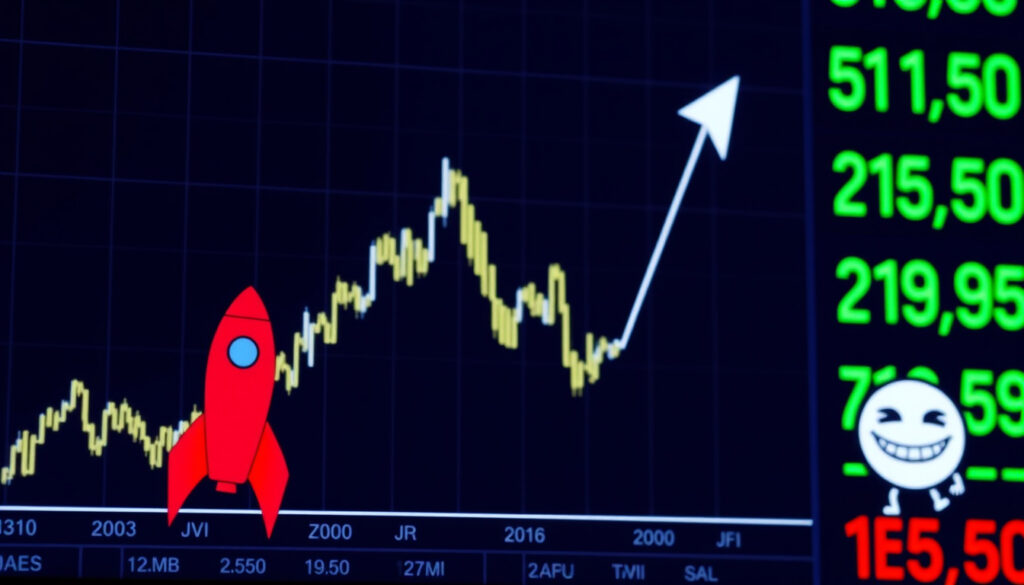
What Is a Meme Stock? Definition, Examples, and Risks
Anyone who watched GameStop’s stock price rocket from around $20 to $483 in January 2021 already knows the basic arc: retail traders on Reddit buying en masse, and Wall Street scrambling to cover short positions — but that single event defined a whole new category of stock where social media buzz, not quarterly earnings, sets the price. Here’s what a meme stock actually is, why people trade them, and the real risks behind the hype.
First major meme stock wave: January 2021 (GameStop, AMC) ·
Typical price volatility: 50-200% intraday swings common ·
Primary social platform: Reddit (r/wallstreetbets) ·
Retail investor participation: Millions of individual traders ·
Average holding period: Days to weeks, not years
Quick snapshot
- Meme stocks are driven by social media coordination (Public.com)
- GameStop and AMC are widely recognized examples (Investopedia)
- High volatility is a defining characteristic (CFA Institute)
- Whether Tesla qualifies as a meme stock (Investopedia)
- Long-term viability of meme stock trading as a strategy (TD Bank)
- Regulatory future of social media-driven trading (CFA Institute)
- January 2021: GameStop short squeeze peaks at $483 (Investopedia)
- March 2024: Trump Media (DJT) goes public via SPAC (TD Bank)
- May 2024: GameStop rallies again after ‘Roaring Kitty’ returns (AvaTrade)
- Regulatory scrutiny likely to increase (CFA Institute)
- New meme stock candidates emerge each market cycle (SoFi)
- Retail coordination tools and platforms continue evolving (Public.com)
Five key facts, one pattern: meme stocks trade on attention, not earnings — and the numbers prove it.
| Label | Value |
|---|---|
| First major meme stock | GameStop (GME), January 2021 |
| Primary platform | Reddit r/wallstreetbets |
| Typical volatility | 50-200% intraday swings |
| Average holding period | Days to weeks |
| Regulatory response | SEC review of social media trading |
What is a meme stock?
A meme stock is a publicly traded company whose share price is driven primarily by social media buzz and retail investor coordination rather than by traditional fundamentals like revenue, earnings, or institutional research. As TD Bank puts it, a meme stock is essentially a stock that has “gone viral.”
The term emerged during the COVID-19 pandemic when locked-down retail traders began organizing in online communities. CFA Institute researchers formally defined meme stocks by their prominence on Reddit’s WallStreetBets forum, using an attention threshold to categorize stocks that cross from normal trading into meme territory.
How social media drives meme stock popularity
- Platforms such as Reddit, X, TikTok, and Discord serve as coordination hubs where retail investors share trade ideas and rally behind specific tickers (Public.com).
- Posts that go viral can attract thousands of new buyers within hours, creating sudden demand spikes that drive price higher — often disconnected from any company news.
- SoFi notes that these stocks are “generally driven by retail investor sentiment on social media rather than the company’s fundamental value.”
Difference between meme stocks and traditional investments
- Valuation basis: Traditional stocks trade on earnings multiples, discounted cash flows, and analyst ratings. Meme stocks trade on buzz, subreddit mentions, and sentiment momentum.
- Volatility profile: CFA Institute found that average unadjusted volatility jumps from 83% before meme status to 106% after a stock becomes a meme. Correlation with other meme stocks surges past 80%.
- Holding period: Traditional investors often hold for quarters or years. Meme stock positions are typically held for days or weeks — sometimes hours.
What is an example of a meme stock?
The most cited examples all share a common pattern: a burst of social media attention, a surge in retail buying, and a price move that defies traditional valuation logic.
GameStop (GME) and the 2021 short squeeze
GameStop is the archetypal meme stock. In January 2021, users on r/wallstreetbets noticed that hedge funds had shorted more GME shares than existed — a short interest of over 100%. Coordinated buying drove the price from roughly $20 to an intraday peak of $483, forcing short sellers to cover at massive losses. Investopedia describes the event as “a striking disconnect between share price and company fundamentals.”
AMC Entertainment (AMC) and retail investor coordination
AMC Entertainment followed GameStop’s pattern weeks later. Retail investors on Reddit and stock-twitch communities pushed the theater chain’s stock from under $5 to a peak above $70 in June 2021. The rally was sustained by repeated social media campaigns, including “AMC to the Moon” hashtags and coordinated buying on specific dates. AvaTrade notes that meme stocks “emerged in 2020 during the COVID-19 recession and then became a common occurrence.”
Trump Media & Technology Group (DJT) as a political meme stock
Trump Media & Technology Group, trading under the ticker DJT, went public via a SPAC merger in March 2024. The stock quickly exhibited classic meme characteristics: extreme daily swings, retail-driven volume, and prices disconnected from the company’s modest revenue. Analysts remain divided on whether DJT is a meme stock or a politically motivated holding — but its trading behavior fits the pattern. TD Bank warns that “meme-stock rallies can collapse once sentiment turns because price gains are driven by crowd psychology rather than fundamentals.”
Each of these examples had a narrative — a “story” that made buying feel like joining a movement. That narrative is what separates a meme stock from a standard speculative trade.
What makes a stock a meme stock?
Not every volatile stock is a meme stock. There are specific, measurable characteristics that separate meme-driven trading from ordinary market speculation.
Key characteristics: high volatility, social media buzz, retail focus
- High short interest: A significant percentage of shares sold short is a common feature, because short squeezes amplify price moves. Public.com identifies short interest as one factor that can help meme stocks emerge through short squeezes.
- Social media volume spikes: Mentions on Reddit, X, and TikTok typically surge days before the price moves. CFA Institute found that once a stock becomes a meme, its correlation with other meme stocks jumps to over 80%.
- Weak fundamentals: The company’s revenue, profit, and outlook are often poor or irrelevant to the price action. Investopedia notes a “striking disconnect between share price and company fundamentals.”
Role of short interest and short squeezes
A short squeeze occurs when a heavily shorted stock’s price rises, forcing short sellers to buy back shares to cover their positions — which pushes the price even higher. Meme stock traders actively target high short-interest stocks because the squeeze dynamic creates asymmetric upside. Moomoo explains that “collective social media hype can drive retail investors to buy shares en masse, sometimes creating a short squeeze.” However, the same dynamic can reverse violently when buying momentum stalls.
Is a meme stock a good investment?
The short answer from every major financial institution that has addressed the question: generally no, not for most people. But the nuance matters.
Pros: potential for rapid gains, community excitement
- Early entrants in a meme stock rally can see 100-500% gains in days. GameStop buyers who got in at $20 and sold near $483 saw a 2,300% return.
- The community aspect creates a sense of shared purpose and entertainment that traditional investing rarely offers.
- Some traders use meme stocks as a small, high-risk allocation within a diversified portfolio, treating the position as a lottery ticket rather than an investment.
Cons: extreme volatility, risk of total loss, lack of fundamentals
- Total loss risk: TD Bank warns that “the biggest risk with a meme stock is losing all of your money.” Rallies driven by sentiment can reverse 50-80% in a single session.
- No fundamental floor: Investopedia frames meme-stock investing as risky because “the share price can be driven by sentiment rather than business performance.” Without earnings support, there is no valuation floor.
- Market manipulation risk: Public.com warns that meme stocks “can be vulnerable to market manipulation, including pump-and-dump schemes.”
- Timing difficulty: The average meme stock rally lasts days to weeks. Selling at the peak requires timing that most retail traders don’t have.
Meme stocks offer asymmetric upside in the first hours of a rally, but the asymmetry flips for anyone who buys after the initial spike. The data from CFA Institute shows volatility actually rises after meme status is reached, meaning risk gets worse, not better, as a stock gains attention.
Why do people buy meme stocks?
Understanding the motivation is essential because meme stock buying looks irrational through a traditional finance lens — and in many ways, it is. The drivers are behavioral, not analytical.
FOMO and social proof
Watching strangers on Reddit post screenshots of life-changing gains creates powerful social proof. The fear of missing out — FOMO — is the single most cited reason for late-stage entry into meme stocks. SoFi notes that retail investor sentiment on social media drives participation, and that sentiment is contagious. When a subreddit’s front page shows 10 posts about GME in a row, the social signal to buy is overwhelming.
Anti-establishment sentiment and ‘sticking it to hedge funds’
A significant portion of meme stock buyers see their trades as protest. The GameStop short squeeze was widely framed as a populist uprising against hedge funds and institutional investors. Buying a meme stock becomes a symbolic act — a way to “fight back” against a financial system perceived as rigged. This narrative is self-reinforcing: the more it gets repeated on social media, the more buyers join.
Entertainment and community belonging
Many meme stock traders describe the experience as fun. The combination of real-money stakes, real-time chat rooms, and shared memes creates a gamified trading environment. AvaTrade describes meme stocks as shares that experience “sharp price moves driven primarily by online attention and retail trading momentum” — and that excitement itself becomes part of the product. For some participants, the entertainment value justifies the financial risk.
Pros and Cons of Meme Stock Trading
Upsides
- Potential for extremely rapid gains in early-entry scenarios
- Community-driven trading creates entertainment and social belonging
- Small allocations can be used as high-risk lottery tickets within a diversified portfolio
- Short squeeze mechanics can produce asymmetric upside in the right conditions (Public.com)
Downsides
- Risk of total loss — rallies can reverse 50-80% in a single session (TD Bank)
- No fundamental valuation floor to support price during selloffs
- High vulnerability to pump-and-dump manipulation (Public.com)
- Average holding period of days means timing pressure is extreme
- Most meme stocks underperform the broader market over 12-month horizons
The implication: the upside is for early movers; latecomers shoulder the risk.
Timeline of Meme Stock History
The meme stock phenomenon has evolved rapidly since its 2021 breakout. Four key moments define the timeline so far.
- January 2021: GameStop short squeeze peaks; stock reaches $483. The event becomes a global news story and defines the meme stock category.
- February 2021: AMC Entertainment follows with a similar retail-driven rally, peaking above $70 by June. AvaTrade notes that meme stocks “became a common occurrence” after this period.
- 2021-2022: Multiple meme stock waves emerge, including Bed Bath & Beyond, BlackBerry, and Nokia. Each follows the same pattern: social media buzz, retail buying surge, sharp price spike, eventual collapse.
- March 2024: Trump Media & Technology Group (DJT) goes public via SPAC merger. The stock exhibits classic meme behavior: high volatility, retail-dominant volume, and price disconnected from revenue. Analysts label it a political meme stock.
- May 2024: GameStop rallies again after Keith Gill (“Roaring Kitty”) returns to social media, reminding markets that the meme stock engine still runs on influencer attention.
Every meme stock wave since 2021 has followed the same sequence: a catalyst post on social media, a surge in retail buying, a short squeeze or momentum spike, and then a collapse when buying exhausts. The timeline is compressed — the entire cycle often takes 2-6 weeks.
What’s Confirmed and What’s Unclear
After three years of meme stock data, some conclusions are solid. Others remain open questions.
Confirmed facts
- Meme stocks are driven by social media coordination, not fundamentals (Public.com)
- GameStop and AMC are widely recognized examples (Investopedia)
- High volatility is a defining characteristic — CFA Institute documents a jump from 83% to 106% after meme status
- Rallies driven by crowd psychology can collapse rapidly (TD Bank)
What’s unclear
- Whether Tesla qualifies as a meme stock — analysts remain divided on whether its price action is meme-driven or fundamental
- Whether Palantir is a meme stock (debated among analysts)
- Long-term viability of meme stock trading as a repeatable strategy — most participants lose money over multiple trades
- Regulatory future of social media-driven trading — the SEC has signaled interest but no comprehensive rules have been proposed
What this means: the evidence on meme stocks is mixed, but the risks are well documented.
Perspectives on Meme Stocks
Financial institutions and reference sources have offered clear, consistent definitions of the meme stock phenomenon. Here are four key perspectives.
“A meme stock is a stock that gains popularity among retail investors through social media.”
— Wikipedia
“A meme stock is essentially a stock that’s gone viral.”
— TD Bank
“A meme stock is one whose trading activity is pumped up via social media.”
— Fidelity
“A meme stock is any publicly traded stock with a price performance strongly influenced by social media activity.”
— Britannica
Every major institutional source — TD Bank, Fidelity, CFA Institute — agrees on the same warning: meme stocks trade on sentiment, not value. The implication for retail traders is that the person who buys earliest wins, and everyone else subsidizes that gain.
Summary
Meme stocks are a genuine new category of financial asset: one where social media coordination replaces fundamental analysis, where holding periods are measured in days, and where narrative matters more than revenue. The behavioral drivers — FOMO, anti-establishment sentiment, entertainment — are powerful enough to sustain the phenomenon across multiple market cycles. For the retail investor considering a meme stock trade, the choice is clear: treat it as entertainment money you can afford to lose, or watch from the sidelines as others chase the spike.
For related financial topics, see our guides on High Yield Savings Accounts Ireland: Best 2025 Rates and NY Inflation Refund Check 2025: Who Gets $400.
Frequently asked questions
What is a meme stock in simple terms?
A meme stock is a stock that becomes popular because people talk about it on social media — not because the company is doing well financially. Its price moves based on buzz and hype rather than earnings or profits.
How do meme stocks work?
Meme stocks work through coordinated buying. Retail investors on platforms like Reddit and X share a stock ticker, create buzz, and buy shares at the same time. This buying pressure pushes the price up, which attracts more buyers, creating a feedback loop. Some of these runs trigger short squeezes that amplify the price move further (Public.com).
What are the most famous meme stocks?
The most famous meme stocks are GameStop (GME), AMC Entertainment (AMC), and Trump Media & Technology Group (DJT). Other notable examples from 2021-2024 include Bed Bath & Beyond, BlackBerry, and Nokia (Investopedia).
Can you make money with meme stocks?
Yes, early entrants in a meme stock rally can make significant gains. GameStop buyers who got in before the January 2021 squeeze saw returns of over 2,000%. However, most late-stage buyers lose money. TD Bank warns that “the biggest risk with a meme stock is losing all of your money.”
Are meme stocks illegal?
Meme stock trading itself is not illegal. However, some coordinated trading activities can cross legal lines — particularly pump-and-dump schemes, where organizers buy in advance, promote the stock to drive the price up, and then sell at the peak. Public.com warns that meme stocks “can be vulnerable to market manipulation.”
How long do meme stock rallies last?
Most meme stock rallies last between a few days and a few weeks. The initial spike often peaks within 48-72 hours of the catalyst post, followed by a period of elevated volatility and a gradual decline. The average holding period for meme stock traders is days to weeks, not months or years.
What is the difference between a meme stock and a growth stock?
A growth stock is a company with strong revenue and earnings growth that trades on its business performance. A meme stock trades on social media attention regardless of its business results. Growth stocks have valuation support from fundamentals; meme stocks have no valuation floor. SoFi notes that meme stocks are “disconnected from fundamentals and extremely volatile.”
More related posts
 T-Mobile Customer Service Number 24/7 – Phone Numbers, Hours & Tips
 100 Grams to Cups: Guide for Flour, Sugar, Butter & More
 Paige DeSorbo Net Worth: Her Earnings vs. Craig Conover
 How Many People Did Genghis Khan Kill? Facts & Estimates
 Cast of Heated Rivalry: Real Relationships & Facts
 2025 vs 2026 Federal Income Tax Brackets Guide
 How to Screenshot on Windows: Keyboard Shortcuts & Fixes
 Kentucky Derby 2025: Start Time, Post Time, TV Schedule