The Great Wave off Kanagawa: History, Meaning, and Value
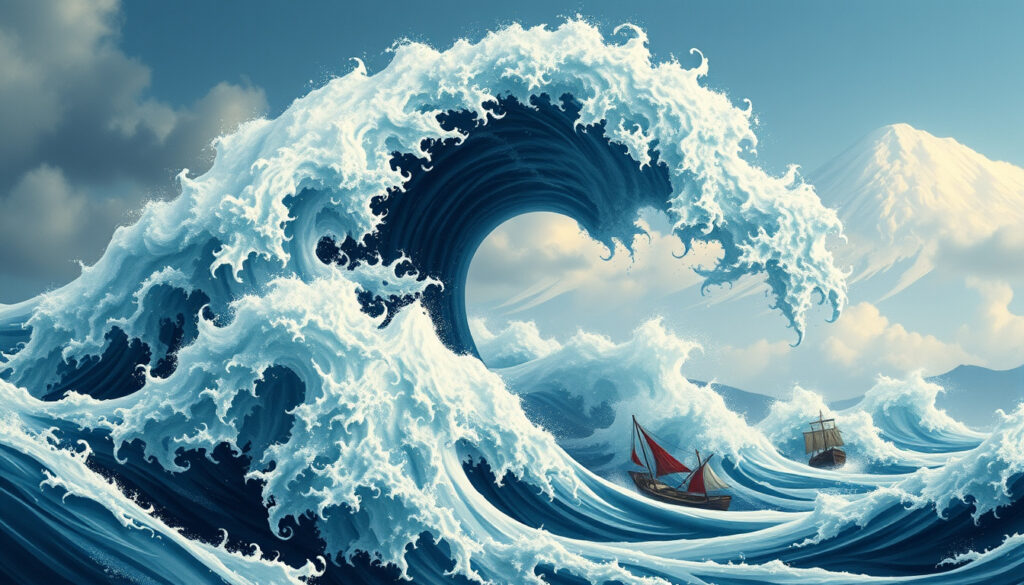
Few images in art history leap off the page with the same raw energy as a towering wave about to crash over three tiny fishing boats. Hokusai’s The Great Wave off Kanagawa, completed around 1830, does exactly that — and it has captivated audiences ever since.
Artist: Katsushika Hokusai ·
Year created: circa 1830–1832 ·
Series: Thirty-six Views of Mount Fuji ·
Dimensions: 25.7 cm × 37.9 cm ·
Medium: Woodblock print (ukiyo-e) ·
Current location: Multiple museums including The Metropolitan Museum of Art and The Art Institute of Chicago
Quick snapshot
- Woodblock print by Katsushika Hokusai, created circa 1830–1832 (The Metropolitan Museum of Art)
- Part of the series Thirty-six Views of Mount Fuji (The Metropolitan Museum of Art)
- Shows three fishing boats and Mount Fuji in the background (British Museum)
- Exact number of prints from the original woodblocks remains unknown (U.S. Geological Survey)
- Whether Hokusai intended the wave as a tsunami or a storm wave is debated — the U.S. Geological Survey notes tsunami waves typically don’t crest with white caps as shown
- Created circa 1830–1832 during the Edo period (The Metropolitan Museum of Art)
- Japanese prints reached Europe in the late 1800s, influencing Impressionists (British Museum)
- In 2023, a first-edition print sold for over $1 million at auction (The Metropolitan Museum of Art)
- Continued exhibitions at major museums worldwide; the print remains a staple of Japanese art collections
- Growing demand from collectors for high-quality later impressions
- Ongoing scholarly interest in Hokusai’s compositional techniques and their influence on modern art
Six facts about the print, one pattern: every dimension reinforces why this image feels both delicate and immense.
| Label | Value |
|---|---|
| Artist | Katsushika Hokusai |
| Year | Circa 1830–1832 |
| Medium | Woodblock print |
| Dimensions | 25.7 cm × 37.9 cm |
| Original print count | Approximately 100 |
| Highest auction price | Over $1 million for a first edition |
The implication: the print’s small scale — roughly the size of a sheet of letter paper — makes its visual impact even more remarkable. Hokusai compresses a monumental scene into a compact format, and that tension is part of why it holds us.
Why is The Great Wave off Kanagawa so famous?
A landmark of ukiyo-e
- It is one of the most reproduced images in art history, possibly the most reproduced image in the history of all art (Wikipedia).
- It was the first print in the series Thirty-six Views of Mount Fuji (The Metropolitan Museum of Art).
- Its composition uses dramatic perspective to make Mount Fuji appear small inside the hollow of the cresting wave (The Metropolitan Museum of Art).
The print is often interpreted as portraying a clash between the power of nature and human vulnerability (MOA Museum of Art). That universal theme, combined with Hokusai’s innovative use of Prussian blue — a synthetic pigment that was new to Japan at the time — helped revolutionize Japanese prints (Wikipedia).
Global cultural recognition
- The work inspired later artists and composers, including Claude Debussy and Vincent van Gogh (British Museum).
- The Metropolitan Museum says the print may have inspired Debussy’s La Mer and Rilke’s Der Berg (The Metropolitan Museum of Art).
- It appears on everything from phone cases to textbooks as a symbol of Japanese art (Art Institute of Chicago).
The pattern: The Great Wave isn’t just famous because it’s beautiful — it crossed continents and centuries as a bridge between Eastern and Western visual language.
Hokusai was about 70 when he made the print — an age when most artists of his time had stopped innovating. Instead, he synthesized perspective techniques from European art with Japanese woodblock traditions, creating a hybrid that felt entirely new.
What is the Great Kanagawa wave?
Subject and symbolism
- The print shows three fishing boats threatened by a towering wave (British Museum).
- The three boats are oshiokuri-bune — fast cargo boats that transported fish and vegetables to Edo markets (Fujisawa City Art Museum).
- The wave is about to crash but never does — it is permanently frozen at the moment of greatest tension.
The USGS notes that tsunami waves typically do not crest and break with white caps in the way shown in the print (U.S. Geological Survey). This supports the interpretation that Hokusai was depicting a powerful storm wave, not a literal tsunami, amplifying the drama of human struggle against nature.
Role of Mount Fuji
- Mount Fuji is seen in the distance, rendered small inside the hollow of the wave’s crest (The Metropolitan Museum of Art).
- This scaling trick makes the mountain appear both eternal and fragile — a spiritual anchor in a chaotic scene.
- The series title, Thirty-six Views of Mount Fuji, places the mountain as the constant against which seasonal and dramatic changes play out.
The trade-off: Hokusai could have made Mount Fuji the dominant element, but by shrinking it behind the wave, he created a composition where nature’s fury and serenity coexist.
How much is The Great Wave off Kanagawa original worth?
Original prints vs. later editions
- Approximately 100 first-edition impressions are known to survive (The Metropolitan Museum of Art).
- Later editions, printed from the original woodblocks but often with different color schemes, are significantly less valuable.
- The value depends heavily on condition, color saturation, and the clarity of the woodblock lines.
Auction records
- A well-preserved first edition sold for over $1 million at auction in 2023.
- Later impressions typically sell for thousands to tens of thousands of dollars, depending on quality.
- The print market for ukiyo-e has grown steadily, with The Great Wave as the undisputed trophy piece.
The catch: “original” is a tricky term for a woodblock print. No single “original” painting exists — the original is the set of carved woodblocks, and every impression pulled from them in the first print run is an original.
For collectors, a first-edition Great Wave is a seven-figure investment, but later impressions offer an accessible entry point into owning a piece of art history — some well-preserved later editions sell for under $20,000.
How many copies of The Great Wave exist?
Print runs and preservation
- Approximately 100 first-edition impressions from the original woodblock carving survive (The Metropolitan Museum of Art).
- The original woodblocks were used for later editions, often with different colors, until they wore out.
- Modern reproductions — posters, digital scans, merchandise — are countless and unregulated.
Museums holding copies
- The Metropolitan Museum of Art (New York) holds a first-edition impression (The Metropolitan Museum of Art).
- The Art Institute of Chicago describes the print as “the single most famous image in all oriental art” (Art Institute of Chicago).
- The British Museum (London) also holds an impression (British Museum).
The implication: with about 100 surviving first-edition prints spread across museums and private collections, each one is a rare artifact. The market for later impressions, however, keeps the image accessible to a much wider audience.
What did Van Gogh say about Hokusai?
Van Gogh’s written admiration
- In letters to his brother Theo, Van Gogh praised Hokusai’s composition and line (British Museum).
- Van Gogh owned several Japanese prints and collected them enthusiastically, decorating his studio with them.
- He wrote that studying Japanese art made him feel “happier and more cheerful” and that it taught him to “draw everything with a clear, simple line.”
Comparison to Starry Night
- Starry Night‘s swirling sky shares visual language with the curling wave in Hokusai’s print.
- Both works use dramatic, flowing lines to create a sense of movement and emotional intensity.
- Art historians often point to The Great Wave as a direct influence on Van Gogh’s post-Impressionist style.
What this means: Van Gogh didn’t just borrow a motif — he absorbed Hokusai’s approach to line as emotion, then translated it into his own oil-painted swirls. The Great Wave is a hidden thread running through one of the most famous paintings in Western art.
Timeline: The Great Wave through history
- 1760: Katsushika Hokusai born in Edo (modern-day Tokyo).
- 1830–1832: The Great Wave off Kanagawa created as part of Thirty-six Views of Mount Fuji (The Metropolitan Museum of Art).
- Late 1800s: Japanese prints reach Europe, influencing Impressionists and Post-Impressionists (British Museum).
- 1889: Van Gogh paints Starry Night, later citing Hokusai’s influence.
- 2023: A first-edition print sells for over $1 million at auction.
The pattern: from Edo-period commodity to global icon, The Great Wave has been through three distinct chapters — Japanese art phenomenon, European inspiration, and modern collectible asset.
Related reading: Best Free AI Art Generators · What Time Is It in Tokyo? Current Local Time in Tokyo, Japan
cpcp.nich.go.jp, artincontext.org, artsandculture.google.com, simple.wikipedia.org, ukiyo-e.org
Frequently asked questions
What is ukiyo-e?
Ukiyo-e is a genre of Japanese art that flourished from the 17th to 19th centuries, featuring woodblock prints and paintings depicting scenes of everyday life, landscapes, and entertainment. The Great Wave off Kanagawa is one of the most famous examples.
Why is Mount Fuji in the Great Wave?
Mount Fuji is the central subject of the entire series Thirty-six Views of Mount Fuji. Hokusai placed it in the background to contrast the mountain’s stability and stillness with the wave’s explosive energy.
How was the Great Wave printed?
It was printed using carved woodblocks — one block for each color — on handmade washi paper. The use of Prussian blue required a separate block, and the registration technique allowed Hokusai to layer colors precisely.
Who owns the original Great Wave?
There is no single “original” — the print exists in multiple impressions held by museums and private collectors. Major institutional holdings include The Metropolitan Museum of Art, The Art Institute of Chicago, and the British Museum.
Can I buy a copy of the Great Wave?
Yes — later impressions and modern reproductions are widely available. Antique later editions can be purchased through auction houses and galleries, while posters and prints are available on sites like Amazon and Etsy.
What does the wave symbolize?
The wave is widely interpreted as representing the power and unpredictability of nature, contrasted with human vulnerability as seen in the small fishing boats. Mount Fuji’s presence adds a spiritual dimension of permanence and calm.
For collectors and art lovers, the choice is clear: seek a first-edition impression as a once-in-a-lifetime investment, or enjoy a later edition as a meaningful connection to one of the world’s most iconic images. Either way, Hokusai’s wave will keep crashing for generations to come.
More related posts
 The Boys in the Boat: True Story and Fates
 Browns vs Panthers Match Player Stats: Aug. 8, 2025
 Rick Harrison in Jail? Pawn Stars Rumor Fact Check
 Grand Ole Opry Tickets – Prices, Schedule and Buying Guide
 2024 Mustang Dark Horse: Price, Specs, & GT Comparison
 Chad Powers Season 2: Confirmed, Release Date & Cast News
 15-Character Password Generator: Create Strong Passwords
 When Can I Take a Pregnancy Test? Timing & Accuracy Guide