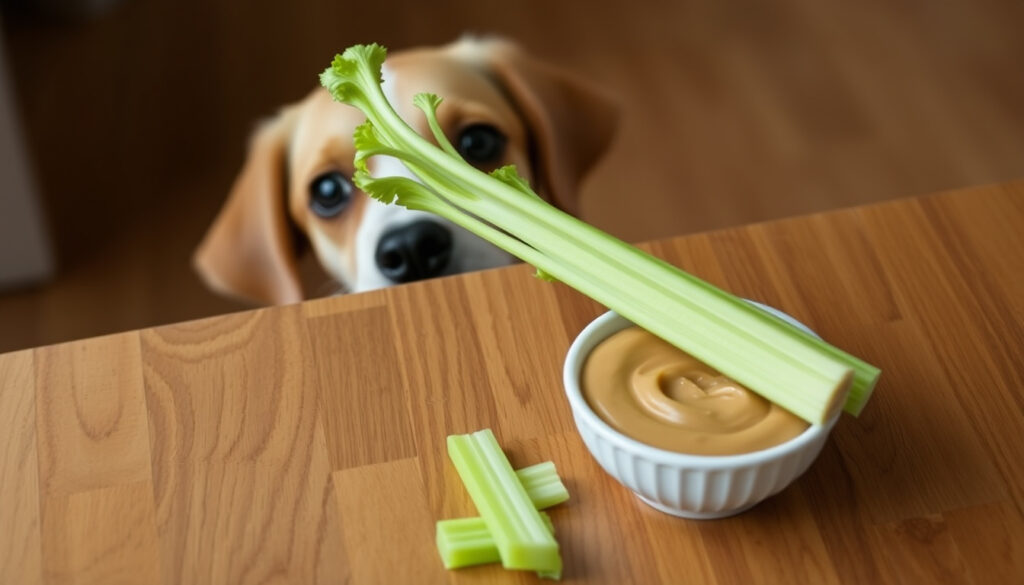
Can Dogs Eat Celery? Vet-Approved Safety & Serving Guide
Few sights are as endearing as a dog giving you the “please share” eyes while you crunch on celery, and the good news is that celery is generally safe for dogs. But safe doesn’t mean unlimited — portion size, preparation, and your dog’s size all matter.
Calories per stalk: ~6 · Water content: 95% · Fiber per stalk: 0.6 g · Vitamin K per stalk: ~24% DV · Safe for dogs: Yes, in moderation
Quick snapshot
- Non-toxic and generally safe (Purina US (pet food manufacturer and nutrition experts))
- Choking hazard – always cut into small pieces (American Kennel Club (national kennel club and pet care authority))
- Avoid seasonings and salt (Chewy (online pet retailer))
- Low calorie treat (~6 cal/stalk) (Pawlicy (pet health insurance platform))
- Rich in vitamins K, A, C (American Kennel Club)
- Hydrating due to 95% water content (PetMD (veterinary health publication))
- Digestive upset if overfed (JustFoodforDogs Blog (veterinary nutrition blog))
- Stringy texture can cause choking (American Kennel Club)
- Not a balanced meal replacement (American Kennel Club)
- Small dogs (under 25 lbs): 1–2 small pieces, 2–3×/week (JustFoodforDogs Blog)
- Medium dogs (25–60 lbs): 2–3 bite-sized pieces, 2–3×/week (JustFoodforDogs Blog)
- Large dogs (60+ lbs): 4–5 pieces, 2–3×/week (JustFoodforDogs Blog)
Five nutritional facts, one pattern: celery is a low-calorie, hydrating snack that fits the 10% treat rule comfortably.
| Attribute | Value |
|---|---|
| Water content | 95% |
| Fiber per stalk | 0.6 g |
| Vitamin K per stalk | ~24% DV for humans |
| Calories per stalk | ~6 |
| Safe for dogs | Yes, in moderation |
Can dogs eat celery raw?
Is raw celery safe for dogs?
- Raw celery is non-toxic and safe for dogs when prepared properly (Purina US).
- Cooked celery (plain, no seasonings) is equally safe (American Kennel Club).
For dog owners, the choice between raw and cooked comes down to texture preference. Raw offers more crunch (and dental scraping action), cooked is easier to chew for older dogs — but neither is nutritionally superior.
Should celery be cut into small pieces?
Yes — the fibrous, stringy texture of celery stalks makes them a significant choking hazard, especially for small dogs. The American Kennel Club advises cutting celery into bite-sized chunks before offering it to your dog (AKC). JustFoodforDogs echoes this: “Celery must be cut into small, manageable pieces to prevent choking.”
A whole celery stick is a choking risk — don’t let your dog gnaw on one unsupervised.
The catch: even with safe preparation, supervision is still recommended.
Can dogs eat celery leaves?
Yes, celery leaves are safe for dogs in small amounts (Chewy). They contain the same nutrients as the stalks but are milder. Wash them thoroughly and chop finely to avoid any digestive irritation.
Is celery a laxative for dogs?
Does celery cause diarrhea in dogs?
Celery’s high water content (95%) and fiber (0.6 g per stalk) can have a mild laxative effect. JustFoodforDogs notes that overfeeding celery can lead to loose stools and upset stomach. Pawlicy adds that excess fiber from celery can cause diarrhea and other gastrointestinal issues.
The catch: moderation is the key. A few small pieces are fine; a whole stalk might send your dog running for the yard.
How much celery can cause digestive upset?
There’s no precise threshold, but veterinary guidance suggests keeping treats — including celery — to ≤10% of daily caloric intake (JustFoodforDogs, AKC). For a 20‑lb dog eating about 400 calories a day, that’s ≤40 calories from treats. One or two small celery pieces (≈6 calories each) fit easily.
Always introduce new treats gradually and monitor your dog’s stool.
What vegetables can’t dogs eat?
What are the most toxic vegetables for dogs?
- Onions, garlic, chives, leeks, shallots — damage red blood cells and can cause anemia (AKC).
- Grapes and raisins — can cause acute kidney failure even in small amounts (Purina).
- Wild mushrooms — many species are toxic; avoid entirely.
For a full list, consult your veterinarian or the ASPCA Animal Poison Control Center.
Why are onions and garlic dangerous?
Both contain thiosulfate, which oxidizes hemoglobin in red blood cells, leading to hemolytic anemia. AKC warns that even small amounts — onion powder, garlic salt — can be harmful. Symptoms include weakness, pale gums, and dark urine.
Can dogs eat grapes and raisins?
No. Grapes and raisins are highly toxic to dogs and can cause sudden kidney failure. The exact toxin is unknown, but reactions vary; some dogs tolerate a few, others suffer severe consequences. Purina states unequivocally: “Do not feed grapes or raisins to dogs.”
What is the healthiest vegetable for dogs?
Are carrots healthy for dogs?
Carrots are rich in beta-carotene (converted to vitamin A) and fiber. They’re crunchy and low in calories — a great alternative to celery for dogs that prefer a sweeter taste (AKC).
Is broccoli good for dogs?
Broccoli is safe in small amounts but contains isothiocyanates, which can cause gastric irritation in large quantities. Pawlicy recommends offering broccoli florets only as an occasional treat — no more than 10% of daily diet.
How does celery compare to other vegetables?
Celery stands out for being ultra-low-calorie and hydrating. Carrots provide more vitamin A, while broccoli offers more fiber but risks gas. For dogs watching their weight, celery is a top pick — just watch the choking risk.
The pattern: variety is best. Rotate between celery, carrots, green beans, and cucumber to cover different nutrients.
How often can dogs eat celery?
Can dogs eat celery every day?
Daily celery is acceptable only in very small amounts — a few tiny pieces. But most experts recommend offering celery 2–3 times per week as part of a varied treat rotation (JustFoodforDogs). Daily feeding risks digestive monotony and potential fiber overload.
What is the recommended serving size for celery?
Size-based guidelines from JustFoodforDogs and AKC:
- Extra-small (under 10 lbs): 1–2 very small chopped pieces
- Small (10–25 lbs): 1–2 small pieces
- Medium (25–60 lbs): a few bite-sized pieces
- Large (60–100 lbs): a small handful of chopped pieces
- Extra-large (over 100 lbs): slightly larger portions, still moderated
Always observe your dog’s reaction the first time — stop feeding if you see signs of upset.
Can puppies eat celery?
Puppies can eat celery in tiny, soft-cooked pieces, starting around 8 weeks. Their digestive systems are more sensitive, so introduce slowly. Purina recommends waiting until adult teeth come in to avoid choking hazards.
Upsides
- Extremely low in calories – great for weight management
- High water content supports hydration
- Contains vitamins K, A, C and fiber
- Crunchy texture may help scrape teeth
- Easily prepared at home
Downsides
- Stringy texture is a choking hazard
- Overfeeding can cause diarrhea or gas
- Not a meal replacement – lacks protein and fat
- Some dogs dislike the taste
- Requires careful cutting for small breeds
What veterinarians and experts say
“Celery is among the vegetables that are safe for dogs and is often recommended as a treat for pets that need to lose weight.”
— American Kennel Club (national kennel club and pet care authority)
“Yes, celery is generally considered to be a safe food for dogs. Although it’s not part of the usual dog food menu, celery can be fed in moderation as a snack.”
— Purina US (pet food manufacturer and nutrition experts)
“Yes, dogs can certainly eat this green treat. It’s not only safe for dogs to eat as a special snack, but celery is very healthy for dogs, too.”
— PetMD (veterinary health publication)
For most dog owners, the decision is clear: offer celery as an occasional crunchy treat, cut into safe, bite-sized pieces, and never let it exceed 10% of your dog’s daily calories. If your dog has a known digestive sensitivity, skip the celery and opt for blander options like boiled green beans. The trade-off is between a healthy, hydrating snack and the risk of digestive upset — one that’s manageable with simple portion control.
Frequently asked questions
Can dogs eat celery seeds?
Celery seeds are not recommended for dogs. They are concentrated and can cause gastric irritation. Stick to fresh stalks.
Does celery help with dog bad breath?
Celery’s crunchy texture can mechanically scrape plaque, which may reduce bad breath. But it’s not a substitute for regular dental care (AKC).
Can dogs eat frozen celery?
Frozen celery is safe and can be soothing for teething puppies, but it’s harder and may increase choking risk. Thaw slightly or cut into very small pieces.
Is celery good for diabetic dogs?
Celery’s low sugar and low calorie profile make it a good option for diabetic dogs, but always consult your vet before adding new foods.
What is the best way to prepare celery for dogs?
Wash, slice into bite-sized chunks (remove strings for small dogs), and serve raw or steamed without salt, oil, or seasonings.
Can dogs eat cooked celery?
Yes, cooked celery (plain, no seasoning) is safe and softer, making it easier for older dogs or those with dental issues.
More related posts
 Ariana Greenblatt Movies and TV Shows – Complete Filmography
 Difference Between Affect and Effect – Rules and Examples
 What Does Black Mold Look Like? Visual Guide, Symptoms & Removal
 Fade Haircut for Men – Styles for Every Face Shape
 10 kg to lbs: Convert 10 Kilograms to Pounds (Exact)
 Comet 3I/ATLAS: Facts vs Fiction on Impact and Aliens
 Trolls (Film) – Plot, Cast, Themes and Reception
 Titans (2018): Cancellation & Ending Explained